
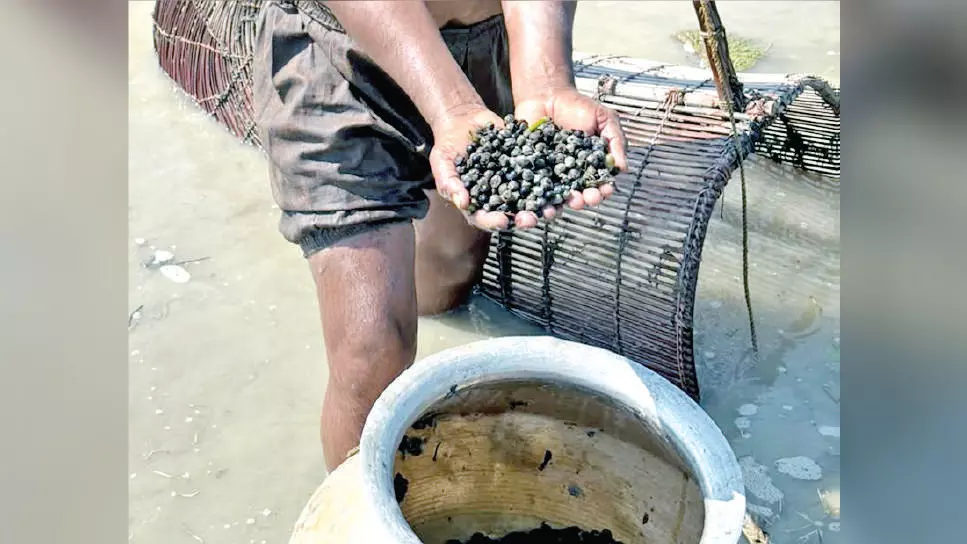
AMINGAON, Nov 2: Assam’s vast wetland resources hold considerable potential for makhana cultivation, which could open up new avenues for agricultural diversification, rural employment and entrepreneurship, experts have said, calling for a scientific and market-oriented approach to develop the sector.
Dr Ramani Kanta Thakuria, Director of Open and Distance Learning, Assam Agricultural University (AAU), said the State has nearly one lakh hectares of natural wetlands that could be harnessed for cultivating makhana, popularly known as fox nut or gorgon nut. Although the exact area under natural growth is yet to be surveyed, it is estimated at 40,000 to 50,000 hectares.
Speaking at the Horticulture Research Station, Kahikuchi, he said the crop grows naturally in several beels and wetlands across Assam. Preliminary studies conducted in 2012 indicated that 50-60 tonnes of makhana seeds were harvested annually from around 10,000 hectares in Jorhat, Sivasagar and Dibrugarh districts.
He said Assam’s humid subtropical climate, high rainfall and abundant water resources favour the crop. Even low-lying areas where paddy cultivation is not economically viable could be brought under makhana through the field method. The crop requires less water than paddy and offers farmers an opportunity to diversify their agricultural activities.
Makhana, valued as a nutritious snack for its low fat content, balanced protein and 18 essential amino acids, also offers employment opportunities in harvesting, drying, grading, popping, packaging and marketing.
Dr Ranjita Bezbaruah, scientist (Agronomy), AAU, said lack of awareness remained a major constraint. Scientific cultivation was necessary to ensure adequate seed production, while shallow water bodies, ponds and lowland rice fields were suitable for the crop.
Dr Thakuria added that the field method required a water depth of around 1 to 1.5 feet and offered higher productivity than traditional pond and beel cultivation. Maintaining open spaces covering 10-20 per cent of the water surface would ensure sunlight penetration and aeration.
Referring to the extensive growth of makhana leaves in Deepor Beel Wildlife Sanctuary between February and April, an expert pointed out that the plant is a preferred food of wild elephants. The animals venture into the wetland to feed on the plant and its fruits, leaving the leaves largely untouched. Their feeding activity also allows sunlight to penetrate the water surface. “This is a natural solution to this natural predicament,” he observed.
On the other hand, Dr Thakuria said the crop required around three metres of water for proper growth and reliable production under the traditional system. Sudden fluctuations in water levels could damage the crop, while the premature drying of natural water bodies due to climate change posed an additional threat. He also stressed the need for quality control, suitable packaging and scientific land-use planning to protect wetland biodiversity and fisheries.
Advocating agro-climatic suitability mapping at the district, block and village levels and pilot projects, Dr Thakuria called for gradual expansion with government support and farmers’ organisations. With a makhana-popping industry already established in Assam, strengthening local production and processing could help meet growing demand across the Northeast and open up national and international markets.