
On the night of the Deepdan (a traditional offering of a lighted lamp), Kamlesh Malaiya stood on the new riverfront in Nakatuwa and looked at something he had stopped expecting to see: a crowd, gathered along the Singri River in celebration.
Between 1,000 and 1,500 people had come to watch lamps glow on the water. With the banks lit up after dark, the evening felt like a festival to him.
The 47-year-old sarpanch of Nakatuwa gram panchayat, with a total population of around 15,000 households, could not stop comparing it with the river of his boyhood.
"Behind my family home in Narsinghpur, Madhya Pradesh, the Singri was once the neighbourhood's washing line, bathing spot and, for many, its drinking water supply. Washermen beat clothes on its stones, children splashed in the shallows, and nobody thought twice about drinking from it. The river was our lifeline," he says with deep fondness.

Then the river changed, so slowly that few people noticed the day it finally became nothing more than a drainage canal. By then, Kamlesh was a grown man.
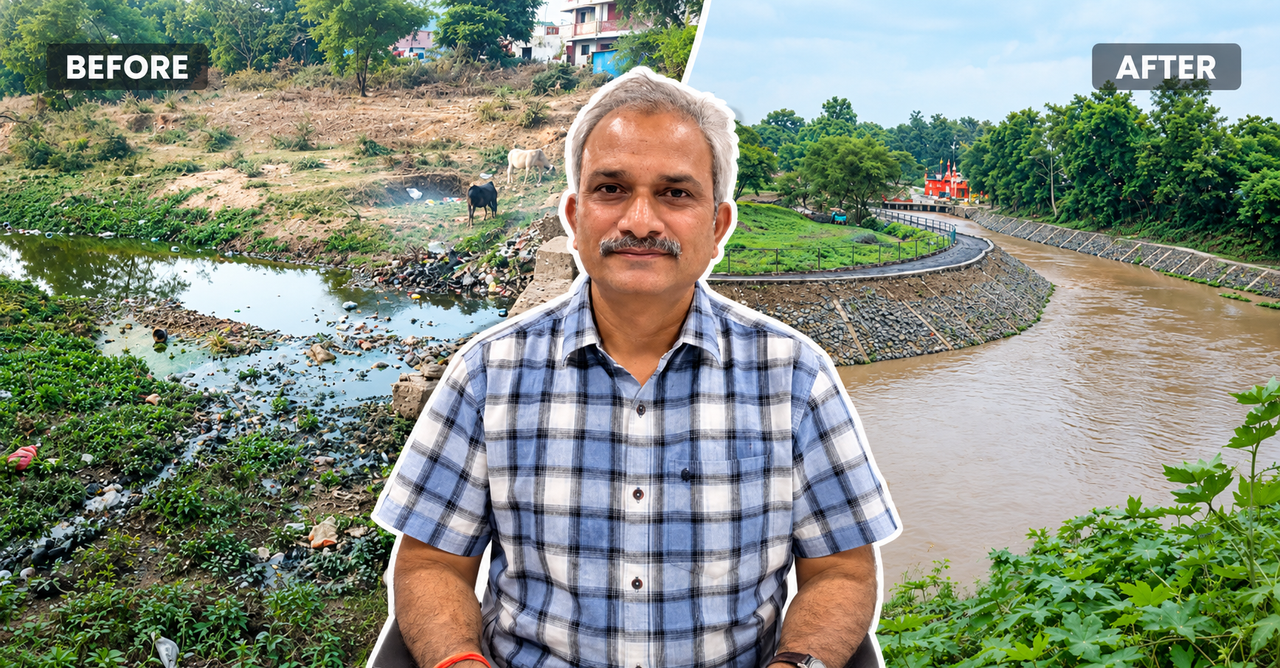
"The Singri had become an open drain, thick with waste and so foul-smelling that standing near it for more than a minute was an ordeal," he says.
Looking at it now, with families walking along its banks, he still finds it hard to believe.
The man who set this turnaround in motion is Gajendra Singh Nagesh, Chief Executive Officer of the Zilla Panchayat, Narsinghpur, who took charge in September 2025. He decided to rebuild the river with gram panchayats, local labour, stone and borrowed machinery, rather than contractors, concrete or steel.
A tributary the Narmada cannot afford to lose
The Singri flows for 39.6 km before joining the Narmada just beyond Narsinghpur town, where around 80,000 people live along its banks. The river originates in the district’s Bachai village with a total approximate catchment area of 3.89 square kilometers. Along its course lie 21 rural local bodies and one urban local body. A district survey counted roughly 25 rivers and streams in Narsinghpur that feed the Narmada.

For a district that spreads across roughly 5,000 sq km of the Narmada valley and has no coastline, glacier or large reservoir of its own, these small tributaries matter more than their size suggests. They are what keep the Narmada alive in the stretches where it would otherwise run thin.
The Singri's troubles were noticed long before this project. Earlier this year, the Narsinghpur municipality had prepared a detailed plan of nearly Rs 15 crore for the town stretch, with stone pitching, and a pathway, and it is under tender process. Encroachment and sewage had already put the river's very existence at risk.
A river That people stopped using
Ask Ganesh Mehra how the Singri declined, and he dates it precisely. The 38-year-old lives 500 metres from the river in Nakatuwa and remembers swimming, bathing and washing clothes there as a young man. After 2000, he says, the river was tied into the sewage and drainage lines, and his family stopped going near it.
In summer, the water thinned out. In the monsoon, it surged back so close to the houses that flooding became a worry in recent years. The smell followed him indoors.
"It used to stink so much that we boiled all our water before drinking it. Now it is much better," he says.

Nagesh saw this version of the river when he first walked it in January 2026.
"The stream was only 15 to 20 metres wide, and in places the bed looked more like an open field than a river," he tells The Better India.
Houses, godowns and vehicle workshops had pushed up against the banks. Travellers on National Highway 44 near Rausara flung sacks of waste into the channel as they passed. Cattle wandered through the bed, grey and black water from the town trickled in, and aquatic life had vanished.
Nagesh had spent 25 years in the administrative service, and water was the one subject that had always held his attention. The Narmada gave the problem its urgency: it does not flow through the year in stretches such as Mandla and Dindori, and relies on its tributaries to stay alive.
"We have no glaciers or any other source. If we are not refilling the river somewhere in between, where will it go? It will end," he explains.
Borrowed machines and a village meeting
Nagesh was determined to act.
"A river, once revered for the life it gave its people, cannot simply perish before our eyes," he says.
He began with the river's banks. His team first spoke to the occupants and then, working with the revenue department, cleared an initial stretch of around 900 metres. Money was the obstacle, because none had been allocated, so he asked other departments for help.

"Tractors, JCBs and Poclain machines arrived for around 800 hours in total, and the project paid only for the diesel. There was an unexpected lesson in it: getting work done without money is easier than getting it done with money. But we had to find a way," he says, recalling the initial days.
On the village side, the first test came in a meeting hall. Rahul Pandey, the 36-year-old secretary of Rausara gram panchayat population approx 8000, took the proposal to the gram sabha on 8 March 2026 and then to the panchayat body. He admits his first reaction was doubt, because nobody in the village had attempted anything of this size.
"When Nagesh sir brought the plan, we wondered how we would do something so difficult and critical, but his motivation carried us through," he says.
The objections arrived as soon as the survey chains came out. Residents had built gardens and private plots on the riverfront, and they argued that the land was theirs. Rahul's answer was procedural and patient: the revenue department measured the land, the structures came down, and, he says, the dispute ended there.
Changing habits before changing the riverbed
Kamlesh describes the order of work as a relay. "First came the cleaning, then the campaign to persuade people to stop dirtying the river, then the stone pitching and the greywater work," he says.

He believes earlier restoration attempts failed because they moved soil without changing habits. "The main thing is to change the mindset of the villagers. Even if the administration succeeds, the river will go back to being a drain if people don't stop littering," he says.
Apart from door-to-door campaigns on cleanliness, waste segregation and littering in public spaces, run by swachhta saathis appointed by the gram panchayats, the administration this time involved villagers directly through shramdaan, the tradition of voluntary community labour.
Nagesh says 50 to 100 people joined from each village at a time from February, while Kamlesh remembers a total gathering of around 200 to 300.

"People came in large numbers to support the campaign. At the village level, they joined cleanliness drives, workshops and campaigns that taught them why we should use public toilets instead of defecating in the open, and why we wanted to revive the river in the first place," Kamlesh explains.
Stone, not concrete
With community support in place, benching became the heart of the engineering work.
Nagesh's team raised the riverbed by two to four metres, shaped benches three to five metres wide with a gentle slope, and pitched both banks with stone along roughly 2,000 running metres. An official had earlier suggested a retaining wall, but Nagesh preferred a bank that would still let soil and water interact. The stone came from crushers in nearby Pataniya village.
Narsinghpur had no local stone workers, so 30 to 40 craftsmen at a time travelled from Chindwada, Amravati and Damoh, and lived and ate on site.

"The approach echoes the Kanchan river work at Singrauli, my previous posting, where a 120-metre gabion structure used no concrete or steel. We wanted the project to remain entirely by and for the people," the officer says.
The work ran alongside Madhya Pradesh's Jal Ganga Samvardhan Abhiyan, a 100-day water conservation campaign from 19 March to 30 June 2026. The project had the support of the state government, but the real pressure came from somewhere else: deadlines.
Nagesh and his team of sarpanches and workers were racing the monsoon in the heat of summer. Kamlesh recalls working day and night, afraid the rain would arrive before the stones had settled.
"We kept fearing that the water would wash everything away. Since the river had become a drain, its water-holding capacity had reduced, so any amount of rain would make it overflow. Working in wet mud and sludge would also have been very difficult," he explains.
The project began in February 2026 and had a tight four-month window to finish by May.
How panchayats and departments built it
The deadline became another reason to decide who would hold the tools.
"We gave none of the work to line departments and routed it through rural panchayats instead, which made the job quicker and more efficient. It also ensured that local leadership would emerge, villagers would own the result, learn to tell good work from bad, and take responsibility for maintenance later," Nagesh says.

He adds that coordination between departments is hard, which made the panchayat route simpler too.
In all, 26 small projects of Rs 10 lakh to Rs 25 lakh each were sanctioned through panchayats, with Rausara, Magardha and Nakatuwa as the three main ones. Nagesh puts the overall sanction at Rs 4.8 crore. “Narsinghpur Collector Rajani Singh helped move the project forward by facilitating administrative clearances and funding support,” Nagesh says.
“We sarpanches managed the timeline pressure by leaning on one another, lending whatever a neighbouring panchayat lacked and asking for help in return. We are all friends and have known each other for a long time, so that made it easier. Whenever there were roadblocks, Nagesh sir really helped and kept us motivated,” says Kamlesh.

"We sarpanches managed the timeline pressure by leaning on one another, lending whatever a neighbouring panchayat lacked and asking for help in return. We are all friends and have known each other for a long time, so that made it easier. Whenever there were roadblocks, Nagesh sir really helped and kept us motivated," says Kamlesh.
Filters, fish and the fight against waste
From day one, the team knew clean banks meant little if waste kept returning, so they worked at the source. Nagesh calls solid waste the biggest lesson of the project. A Zilla Panchayat team and swachhta saathis went door to door, households were asked to separate wet and dry waste, and Rausara began fining open defecation Rs 500.
In Nakatuwa, Kamlesh and his neighbours kept watch through the night to stop the practice, scolding offenders until it ended. Self-help groups also run a Bartan (utensil) bank, lending sets of 100 plates, glasses, bowls and spoons for community functions so that families skip disposables, and two units now make leaf plates.
By Nagesh's estimate, the village-level composting model has cut waste by around 80%.
The most important part of the project, however, was the installation of six mini filtration plants (2 Installed, 1 under contraction & 2 will install in 1 month) at points where drains carrying sewage from the villages enter the river. They have come up across four gram panchayats: Rausara, Magardha, Nakatuwa and Khamtara.

Each is a concrete, chambered structure connected directly to the village drains, and none of them needs electricity. Water simply flows through under gravity.
“The technique is rather simple. Just as science projects show water being filtered through various materials that catch sediment, the filter works in a similar fashion. Several materials hold and separate the waste, and the water flows on into the river. With this, we have seen a significant improvement in the quality of the river water,” the IAS officer explains.
The first barrier is a set of screens that catch polythene, sludge and other solid waste before it can reach the river.
The water then passes through a three-stage natural treatment. In the first stage, screening to hold back plastic and large debris. In the second, a settlement tank for silt.
In the third, used finer gravel & quads sands to trap smaller suspended particles. Plants specific plant species (Canna Indica, Lemon Grass, Cyperus) helps reduce harmful microorganisms and organic impurities. Only then does the water flow into the Singri. Because the system has no moving parts, the gram panchayats themselves will clean the screens periodically and clear the trapped waste.
However, Nagesh is also practical about water quality. “The river water is not yet within permissible limits, because it needs more filters. The administration's next target is to bring in all 14 gram panchayats along the banks and install more of them,” he says.
Meanwhile, there is another sign of the river slowly but surely coming back to life.
"The best part of the project is that aquatic life is returning. For decades there were no fish here. Now we regularly spot several freshwater species. While water quality is still improving, it is great encouragement to see nature returning," Nagesh says, with excitement in his voice.

Kamlesh, too, is candid about the timeline. The drains are still connected to the river, and he says the whole job should be complete this year. A plastic processing unit of around Rs 1 crore is also planned at Nakatuwa to serve about 35 gram panchayats, with plastic-mixed paver blocks among its intended products.
"That is the next vital step, to ensure the plastic we stop from going into the river has another sustainable way to be treated and reused," he explains.
A riverfront the people have claimed
The riverfront has started to do what Nagesh hoped. About 600 metres now have a community hall, a cafeteria and an open-air theatre, and around 100 acres along the banks and adjoining land have been planted with local species. Older residents have claimed the space as their own.

"Women and senior citizens come with their sticks and sit there. I told them they must come, because if they are sitting there, wrong things will not happen," Nagesh says. When someone does litter, others now clean up and send him videos of it.
"If we could do it, so can others"
For a project of this magnitude, with a budget as small as Rs 4.8 crore and a timeline as short as four months, a vital question comes up: is this replicable?
Nagesh's answer is simple. "If we can do it, so can others. Our waterways are very important to people, livelihoods and the overall economy and environment," he says.
He breaks it down into steps most administrations can follow. "Shrinking large projects into smaller sections that benefit a few communities at a time is key, and employing the very communities that benefit from the resource is vital. Not only does this create a sense of ownership, it also makes the budget more workable in the long run. The rest, of course, is administrative will. If one is determined to make something happen, everything works out," he says.

Kamlesh hears the change in what his neighbours tell him. People who once called the job impossible now stop him to say it is happening. He credits Nagesh, who sometimes turns up at the river in the small hours.
Nagesh has one aspiration for the river. "Before I get orders for my next posting, I want to coordinate with all 14 gram panchayats along the banks and complete the project. I feel personally connected to this river and its people, and I want to do the best possible job here," he says.
A full circle
Back on the Singri's banks, the Deepdan was ending. The crowd had thinned, and the last lamps drifted downstream, small flames carried by water that had once been too foul to stand beside.
Kamlesh stayed behind. He crouched on the new stone steps, the same river his mother once drew water from, and watched the light move across it. Somewhere in the shallows below, a fish turned, a sight no one in Nakatuwa had seen for decades.
"As a boy, I drank from this river without a thought, and then I watched it die without being able to do anything," he says quietly. "Now, the generations after me can stand where I'm standing, and the river is still there for them."
Then, as he had done as a child, he cupped his hands and touched the water. It was cool and clean, and for the first time in a very long while, it felt like home.