
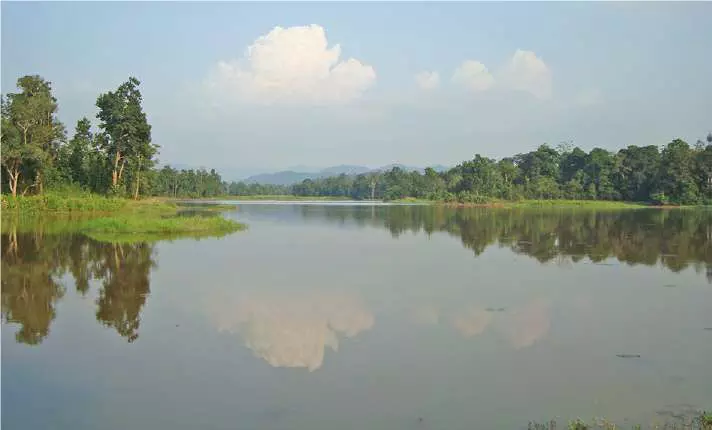
Chandubi Lake
AMINGAON, Nov 28: The Forest department will submit a proposal to the State government seeking designation of Chandubi Lake as a Ramsar Site in recognition of its importance as a wetland of global significance.
Speaking to The Assam Tribune, Divisional Forest Officer of Kamrup West Forest Division Ashok Kumar Dev Choudhury said he would submit the proposal shortly, following instructions from Kamrup District Commissioner Deba Kumar Mishra. “The Kamrup District Commissioner has asked me to submit a proposal to initiate the process of according Ramsar Site status to Chandubi Lake,” Dev Choudhury said, adding that preparations in this regard had already begun.
Already recognised as an Important Bird Area (IBA) under Category A1, the quake-born lake is considered to have the potential to qualify for international recognition under the Ramsar Convention, 1971.
Earlier, a survey conducted by the Bombay Natural History Society (BNHS) identified Chandubi Lake as a potential Ramsar Site. The wetland supports threatened ecological communities and falls under Ramsar wetland type O, which denotes a permanent freshwater lake. Its secluded location and relatively low biotic interference make it an important habitat for a wide variety of avifauna.
The lake is situated within the Borduar Reserved Forest under the Loharghat Forest Range, while the Mayang Hill Reserved Forest lies to its south. The reserve forest status of Borduar was notified in 1876, while Mayang received the status in 1883. A major feeding channel, about 2.5 km long, connects the wetland with the Kulsi river.
According to BNHS findings, the Lesser Adjutant and Pallas’s Fish Eagle are the prominent threatened bird species found in the area. The lake also attracts a large number of waterfowl.
The adjoining tropical moist deciduous forests harbour several biome species of conservation interest, including the White-cheeked Hill Partridge, Blyth’s Kingfisher, Blue-throated Barbet, White-throated Bulbul and Grey Peacock Pheasant.
The wetland is surrounded by low, undulating hills, with sal as the dominant tree species, along with teak.
Dr Aparna Jyoti Rabha, an entrepreneur associated with Rabha Agrotech, welcomed the proposed move, observing that the wetland, with its dendritic shoreline, had so far failed to receive the recognition it deserved despite its natural endowments.
“The wetland should have been accorded global recognition considering its immense ecological significance during its heyday,” Dr Rabha said, adding that such recognition would help the lake regain its past glory.
Based on its geomorphological origin, Chandubi belongs to Tectonic Group Type 5. The wetland currently covers an area of 4.5 square km, compared to its original area of about 712 hectares (7.12 square km). Its mean depth is 1.46 metres, while its full supply level (FSL) depth is 4.2 metres.
Migratory birds such as Bar-headed Geese, Northern Shovelers, White-eyed Pochards, Brahminy Ducks, Mallards and Red-crested Pochards are also reportedly sighted in the wetland.
Besides receiving water from the Kulsi river, the wetland is fed by seven inlet streams, of which Charaikhorong is considered the second most important. The lake, which once harboured gharials, also boasts rich fish diversity, with more than 70 species, including Nandini and the commercially valuable Chital.