

Can India Build Its Own Anthropic?
Anthropic’s blockbuster listing has put India’s AI ambitions under a harsh spotlight. The IPO has triggered a debate over whether the country can build globally competitive AI companies. So, can India build its own Anthropic before the next AI wave passes it by?
The Boardroom Debate: The debate began after Kotak Mahindra Bank founder Uday Kotak said that Anthropic’s $1.5 Tn valuation eclipsed the combined m-cap of India’s ten largest firms. He also questioned whether Indian businesses needed to catch up with the new tech economy. However, ex-Infosys CFO Mohandas Pai urged founders to focus on deeptech R&D to build local champions. But the story is more nuanced than it appears.
The Funding Chasm: On paper, India’s AI funding momentum looks brisk. Domestic AI startups raised a record $1.1 Bn in 9M 2026 despite a subdued funding market. Yet much of the funding flowed into vertical AI rather than foundational research as investors steered clear of cash-guzzling LLM startups. Valuation froth isn’t making things any easier.
The Talent Bottleneck: Even if venture inflows accelerate, replicating an Anthropic-scale powerhouse requires far more than capital. India needs deeper research talent, technical founders and infrastructure to build sophisticated AI models. Until those pieces come together, India’s AI ecosystem may remain strong at distribution but weak at invention.
Becoming An AI Creator: The next phase of India’s AI story will depend on whether founders, investors and policymakers can back ambitious, capex-intensive ideas before commercial returns are visible. Vertical AI may offer quicker revenue, but global scale will come from proprietary technology and foundational innovation.
So, can India build the research depth and risk appetite needed to produce its own Anthropic? Let’s find out…
From The Editor’s Desk
 Inside ShareChat’s Revival
- Mohalla Tech, the parent of ShareChat, Moj and QuickTV, crossed ₹1,000 Cr in operating revenue for the first time in FY26. However, what played spoilsport for the homegrown social media giant was net loss also widened 79% YoY to ₹1,978 Cr.
- The launch of QuickTV opened a crucial new revenue stream and generated nearly a third of Mohalla Tech’s total income in FY26. This pivot helped buffer against advertising headwinds in the aftermath of the ban on real-money gaming last year.
- The startup’s management expects FY27 revenue to exceed ₹1,500 Cr with nearly ₹25 Cr in full-year EBITDA profit. It is also eyeing a $400 Mn IPO in late 2027, subject to achieving a full year of operating profitability in FY27.
 Paytm Goes Globetrotting
- The fintech major’s board has approved an investment of up to ₹200 Cr in subsidiaries of Singapore-based Funding Societies. While ₹162 Cr will be used to acquire a 19.1% stake in CardUp, ₹38 Cr could be infused in another one of Funding Societies’ affiliates.
- The listed giant expects to complete the deal by May 2027. Alongside, Paytm has also signed a five-year deal to offer payments and lending technology support to CardUp, which allows users to pay recurring expenses using a credit card.
- Separately, the fintech major also said that it has completed an additional investment of ₹500 Cr in its subsidiary, Paytm Cloud Technologies Limited. In turn, PCTL invested another ₹500 Cr in Paytm Singapore.
 UPI MDR Rollout Delayed Again
- The re-introduction of a merchant discount rate on select UPI transactions could be delayed until after the 2027 state elections. This comes as the government appears concerned over a potential backlash from merchants and trade associations.
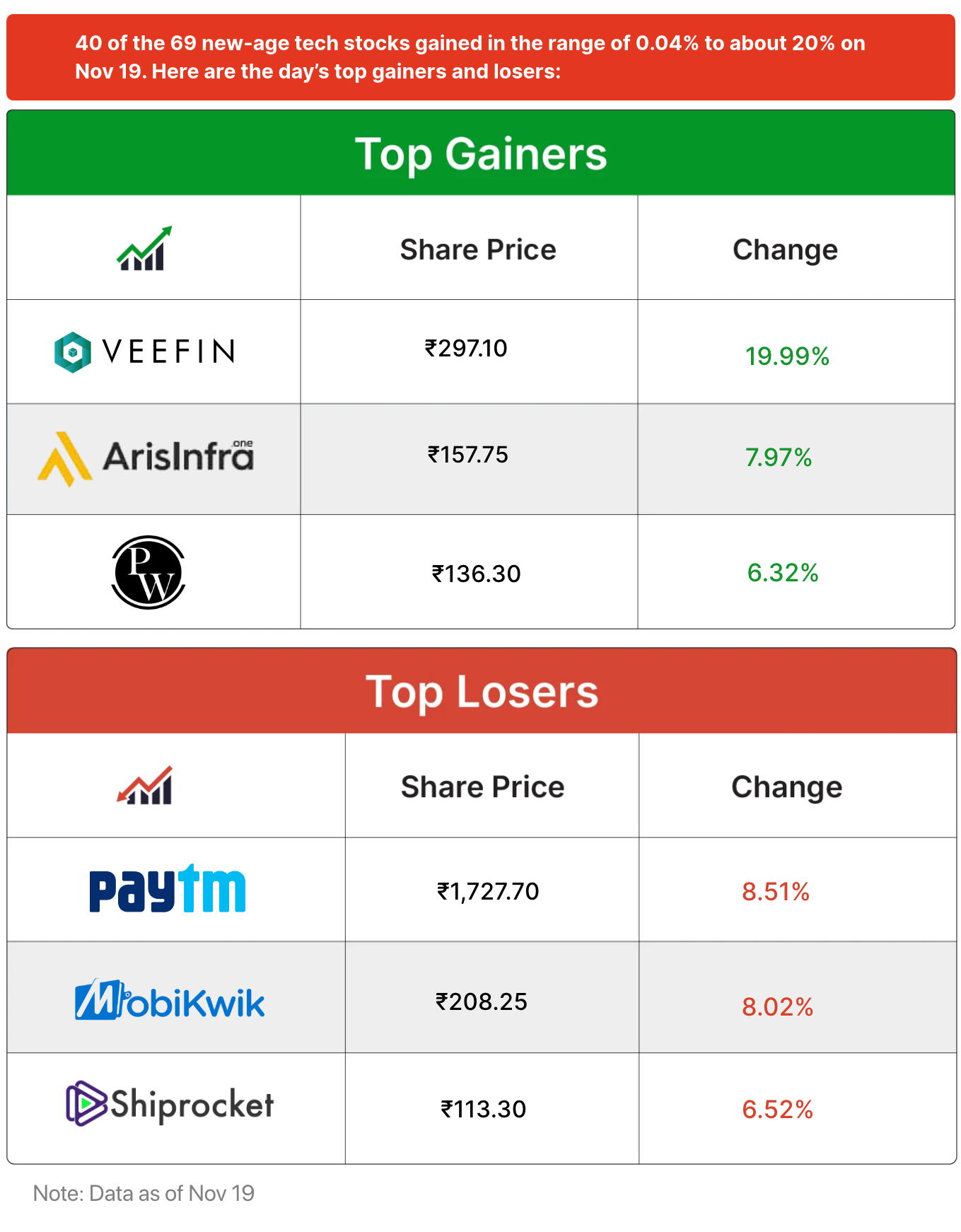
- As reports began to flood about further delays in MDR implementation, shares of fintech companies including Paytm, Pine Labs, and MobiKwik fell sharply during intraday trading. This is the second time that the rollout has been deferred.
- Under the proposed MDR framework, P2M UPI transactions above ₹2,000 would attract a levy of 0.4%, capped at ₹300 for transactions of ₹75,000 and above. Transactions of up to ₹2,000, P2P transfers, and eligible small-merchant transactions will remain exempt.
 Razorpay Eyes 2027 IPO
- The fintech major could file its updated DRHP with SEBI as early as next week. Following this, the unicorn plans to begin roadshows to woo investors for its IPO, which could happen as soon as February 2027.
- This comes days after the market regulator cleared Razorpay’s potential ₹6,000 Cr public issue, which could value the fintech giants at around ₹47,000 Cr. This is about 33% lower than the $7.5 Bn valuation it commanded in its last funding round in 2021.
- Founded in 2014, Razorpay offers payment processing, business banking, payroll and lending solutions. It raised over $800 Mn from marquee investors and closed FY25 with a top line of ₹3,783 Cr.
 August AI Bags $12 Mn
- The healthtech platform has raised around ₹111 Cr from Accel, Peak XV Partners and Claypond Capital to scale its AI assistant for users in the US.
- Founded in 2022, August offers an AI-powered health companion that helps users understand their symptoms and medical reports. The chatbot also enables users to book doctor appointments, find medicines, and follow up on insurance claims in the US.
- The fundraise comes amid rising investor interest in startups using AI to manage healthcare workflows. At the heart of August’s ambition is the global healthtech market, which is projected to become a $3.1 Tn opportunity by 2033.
Inc42 Markets
Inc42 Startup Spotlight
How ULOOK Is Tracking Ships That Go AWOL
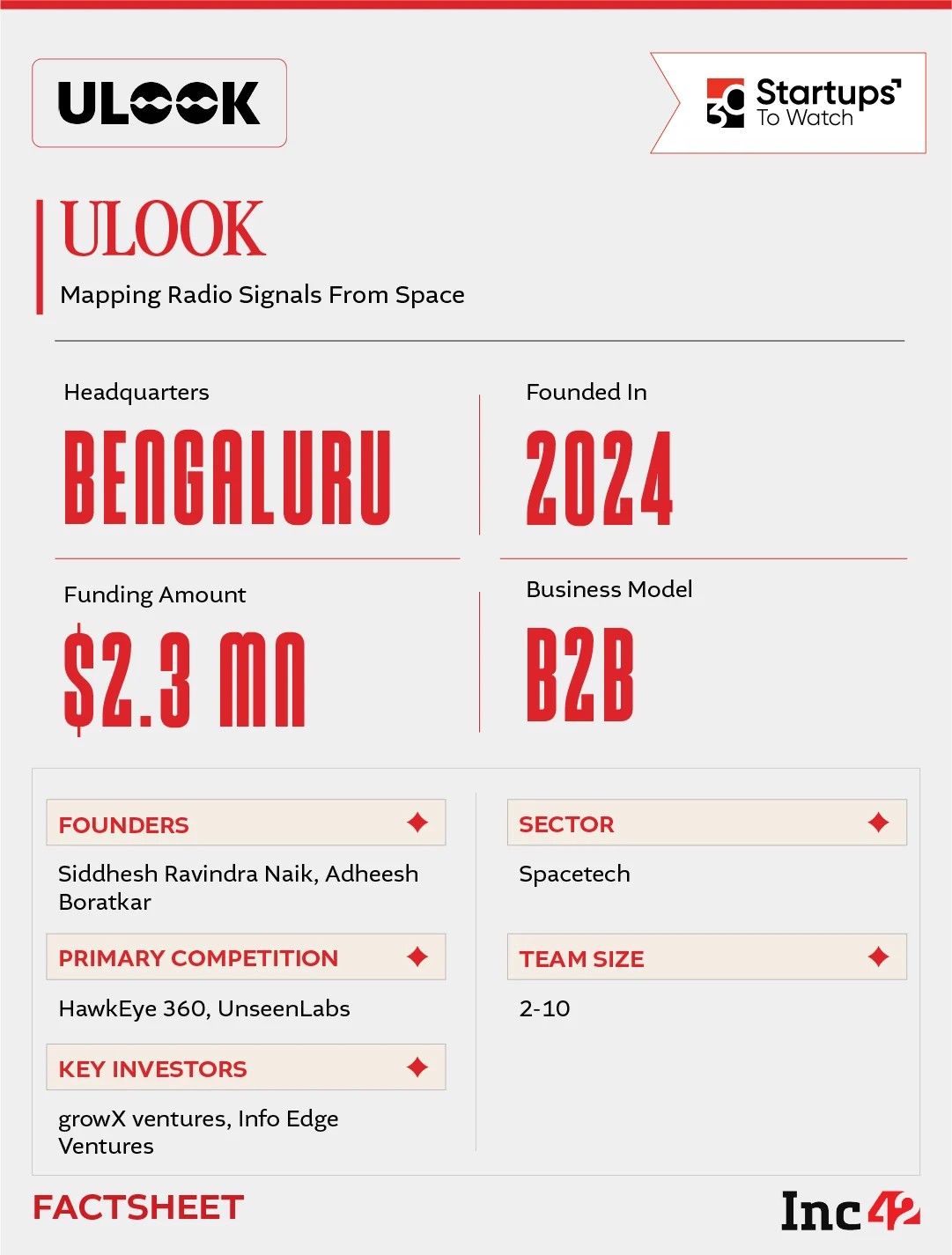
A ship can disappear from conventional trackers by simply switching off its transponder, leaving vast stretches of ocean unmonitored. To solve this, ULOOK is building a swarm of satellites that can detect radio frequency (RF) signatures constantly emitted by these ships.
Sensing The Spectrum: Founded in 2024, ULOOK is developing autonomous satellite constellations for RF sensing and spectrum awareness. Its satellites use AI and inter-satellite links to coordinate as a swarm, allowing coverage across large areas rather than relying on ground stations for every task.
The startup claims that its tech stack can detect concealed radio markers, track movement and determine how long a vessel has stayed in an area.
ULOOK’s Geotech Layer: The startup’s proprietary PulseTrack payload suite is designed to identify, classify and geolocate emitters using their unique signal signatures. It also supports maritime domain awareness, dark-ship detection, disaster response, environmental monitoring and spectrum security. It plans to target defence and infrastructure monitoring use cases.
Charting New Horizons: Backed by growX and InfoEdge Ventures, the startup now plans to focus on payload qualification, hardware-software integration, UAV testing and the development of its first prototype. It aims to launch its first RF-sensing satellite swarm within the next 12 months.
With India’s space economy projected to become a $44 Bn opportunity by 2033, can ULOOK’s swarm deliver reliable RF intelligence at scale?
Infographic Of The Day
From grooming and skincare to fashion, fitness and wellness, a growing set of Indian startups is building for the modern Indian man. Here are the 22 homegrown brands making their mark in the space…

The post India’s Anthropic Question, ShareChat’s Turnaround & More appeared first on Inc42 Media.