
PALASBARI, Nov 20: Located about 60 kms from Guwahati and seven kms from Chandubi Beel, Ranikhamar is a tribal village situated along the Assam-Meghalaya border in South Kamrup under the jurisdiction of the Rabha Hasong Autonomous Council (RHAC). Situated on the banks of the Kulsi river in Palasbari Legislative Assembly Constituency, the village has immense agricultural potential, with farmers traditionally cultivating paddy, sesame, mustard, coconut, areca nut, betel leaf, black pepper, banana and orange.
Among these crops, sesame cultivation holds a special place in the village, with a tradition dating back nearly 150 years. What began during the time of their great-grandparents has been carried forward through successive generations, making Ranikhamar a traditional sesame-growing village in the region.
Recalling the age-old practice, 68-year-old farmer Binudhar Rabha said that villagers collectively cultivate sesame on around 32 bighas of land. “Sesame cultivation is an age-old tradition in our village. It was started by our great-grandparents, continued by our fathers and is now being carried forward by our generation. This community tradition has continued for nearly 150 years,” he said.
Another elderly farmer, 75-year-old Rindu Rabha, said he has been cultivating sesame on his two bighas of land for several years. He is expecting a yield of at least one quintal per bigha this season.
According to him, sesame is generally sold at around Rs 100 per kg, while retail prices can reach up to Rs 200 per kg during the Magh Bihu season. He added that farmers do not face major marketing difficulties, as there is a steady demand for the produce.
The younger generation has also continued the tradition. Jayanta Rabha (45) and his wife Sanjita Rabha (37) have been cultivating sesame on 2.5 bighas of their seven-bigha land for the past three years. They sell their produce at prices ranging from Rs 100 to Rs 160 per kg and are expecting a yield of around one quintal per bigha this year.
“Our land is predominantly sandy, and cultivation becomes difficult during the dry season. We sow sesame during the rainy season. Due to the shortage of water, even paddy cultivation is difficult, as the crops often dry up,” the couple said.
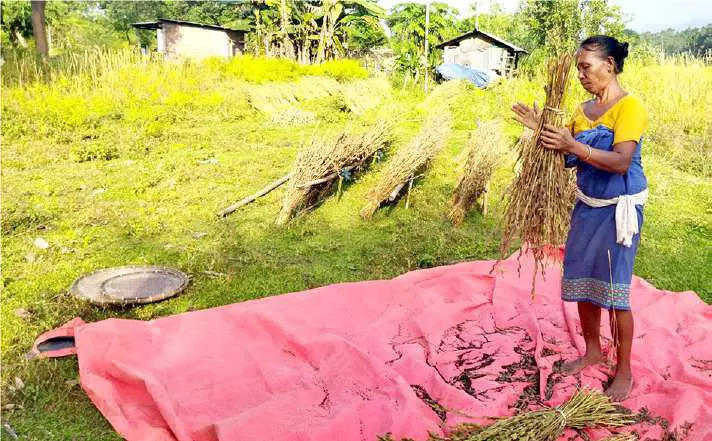
With the harvesting season now underway, members of several farming families are busy collecting their sesame crops. Even villagers who do not own agricultural land are finding seasonal employment in the fields. Runa Rabha and Nirada Rabha, who do not have sesame fields of their own, have joined other farmers as daily-wage labourers. Runa Rabha said women workers receive Rs 300 per day, while men are paid Rs 350.
Despite the considerable potential of sesame cultivation, the absence of proper planning, modern agricultural techniques and institutional support has prevented farmers from expanding the activity on a commercial scale.
Farmers in Ranikhamar have access to nearly 200 bighas of sandy riverbank land along the Kulsi river. However, as the river dries up during the winter months, the sandy stretches become almost barren. Consequently, farmers sow sesame during the Bhadra-Ahin period, relying largely on rainfall, and harvest the crop towards the end of the rainy season. Following the harvest, much of the land remains unused.
Despite depending largely on rainfall, farmers have been able to generate encouraging returns from sesame cultivation. This indicates the considerable scope for expanding the crop through scientific farming practices, improved seeds, irrigation facilities and proper agricultural planning.
With appropriate technological support and government intervention, farmers could potentially utilise the same plots for multiple cropping cycles annually, thereby increasing productivity and income.
However, the absence of such facilities and a comprehensive development plan has left a considerable portion of potentially productive agricultural land underutilised.
Given the village’s century-old tradition and promising agricultural prospects, farmers believe that a dedicated government initiative could transform sesame cultivation into a sustainable commercial venture.
The question remains whether the Assam government's Agriculture Department will introduce a special development scheme to promote sesame cultivation in Ranikhamar and help its farmers turn this traditional practice into a more profitable source of livelihood.