
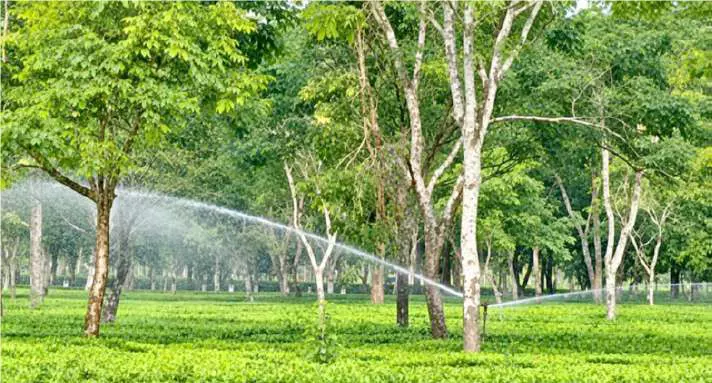
The growing dependence on sprinklers has brought additional financial pressure on estates, with pumping arrangements, electricity, fuel, maintenance and labour adding to cultivation costs.
Doomdooma, Nov 17: The sight of artificial rain falling over endless stretches of tea bushes is becoming increasingly common across the tea belt of Tinsukia district, especially in the Tea City Doomdooma, offering a striking reminder of how changing weather patterns are compelling Assam’s tea industry to adapt to a new climatic reality.
As prolonged dry spells and erratic rainfall are depleting soil moisture, tea estates are increasingly turning to sprinkler irrigation to keep their plantations alive and sustain fresh-leaf production. The once rain-dependent gardens are now having to rely on costly artificial irrigation to maintain their familiar green landscape.
“Tea is a crop that responds to the rhythm of nature. When rainfall becomes irregular and the soil loses moisture, the bushes cannot produce fresh shoots at their normal pace. Sprinkler irrigation can provide temporary relief, but it increases the cost of cultivation and cannot completely compensate for the natural conditions required for healthy tea growth,” said Brahmananda Jha, a retired tea garden manager.
He pointed out that the prolonged dry spell during the autumn flush could affect both leaf availability and the manufacturing season.
The impact is already visible in several plantations, where tea bushes have lost their characteristic deep green hue, with leaves turning pale and fresh shoots emerging slowly. For growers, the concern goes beyond the changing appearance of the gardens. Inadequate soil moisture can disrupt plucking cycles, reduce tender leaf production and affect the supply of green leaves to tea factories.
The India Meteorological Department’s district rainfall report dated November 14 shows that Tinsukia received 116.6 mm of rainfall between October 1 and November 14 against the normal 134.5 mm, registering a deficit of around 13.3%. The district recorded no rainfall on November 14 against a normal of 0.3 mm. The wider assessment also indicates below-normal rainfall across much of Assam during October.
For tea plantations, however, the distribution and timing of rainfall are as important as the seasonal total. Longer intervals between showers can leave bushes under moisture stress even when the overall rainfall deficit appears moderate.
The timing is particularly significant as November falls within Assam’s fourth harvesting period, commonly known as the autumn flush, which generally extends from October to December. A shortage of tender leaves during this phase can affect factory operations and reduce seasonal production.
The difficulties are also being felt by factory workers. “We have been leaving the factory early these days because there are not enough green leaves to process. Factory officials have told us that, owing to the shortage of green leaves, there will be no work towards the end of November,” a tea factory worker said.
The growing dependence on sprinklers has brought additional financial pressure on estates, with pumping arrangements, electricity, fuel, maintenance and labour adding to cultivation costs. For an industry already grappling with rising input expenses and ageing plantations, climate stress has emerged as another formidable challenge.
The problem is not confined to Tinsukia. Studies and recent investigations have highlighted declining rainfall and rising temperatures across Assam’s tea-growing areas. Data cited from the Tea Research Association indicate that rainfall in Assam declined by more than 250 mm between 1921 and 2024, while minimum temperatures rose by 1.2 degrees Celsius.
Tinsukia, whose association with tea dates back nearly two centuries, stands at the heart of this unfolding challenge. Indigenous tea plants were reportedly discovered in the Sadiya region in 1823, while the first English tea garden was established at Chabua in 1837. The region subsequently emerged as one of Assam’s principal tea-producing centres.
The India Meteorological Department had forecast isolated to scattered rainfall over Assam and Meghalaya during November 15-16 and November 19-21. Its district forecast also indicates the possibility of one or two spells of rain or thundershowers in Tinsukia on November 16, although sustained rainfall remains uncertain.
For the tea industry, the question is no longer merely when the next shower will arrive, but whether nature will restore the regular rhythm of rainfall needed to sustain production.
As sprinklers continue to shower the thirsty bushes, Tinsukia’s tea gardens present a telling picture of an industry caught between its rain-dependent past and an increasingly uncertain climatic future. Artificial rain may offer temporary relief, but the natural balance of rainfall, humidity and temperature remains irreplaceable.