
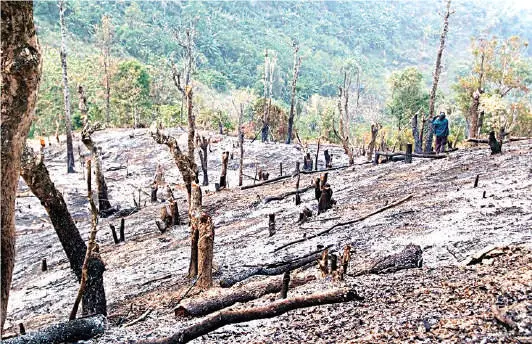
The state government stated Jhum cultivation, encroachment and development works as key factors for forest cover loss
Guwahati, Nov 3: Shifting cultivation, encroachment along inter-state borders and diversion of forest land for development projects have been identified by the Assam government as the key factors behind the recent decline in the State’s forest cover.
In an affidavit filed before the National Green Tribunal (NGT), the State government acknowledged a loss of 86.66 sq km of forest cover (between 2021 and 2023) within its Recorded Forest Area (RFA)/Green Wash, as reported in the India State of Forest Report (ISFR) 2023.
However, it sought to put the decline in perspective, pointing out that Assam has recorded a net increase of 748.65 sq km in forest cover since 2013, marking a growth of 2.72 per cent over the decade.
The NGT had initiated suo motu proceedings following a news report published in The Assam Tribune in 2024 on the decline in forest cover in the region.
According to the State government, Dima Hasao district accounted for the largest share of the recent decline. It attributed the loss primarily to the traditional practice of jhum cultivation in Unclassed State Forest (USF) areas, over which the forest department has no administrative control.
“Additionally, 95.55 sq km (9,555.497 hectares) of forest land in the district was diverted for development work between 2020 and 2025,” the government stated in its submission.
In Cachar and Hailakandi districts, which witnessed a decline of over 16 sq km each, the government blamed severe encroachment from across the inter-state border with Mizoram.
In Chirang district, where forest cover declined by around 14 sq km, the State attributed the loss to encroachment by local indigenous communities, adding that the government was in the process of carrying out eviction drives.
The government further argued that more than 100 sq km of forest land had already been cleared of encroachment across the State but was yet to regenerate. Taking this into account, it maintained that the “actual forest loss is very minimal or nonexistent”.
An amicus curiae report examining the submissions made by various northeastern states, however, flagged significant institutional and administrative challenges in Assam’s forest conservation efforts.
The report noted that Assam’s submission underscored the forest department’s limited administrative control over USF and the difficulties in managing forest areas affected by inter-state boundary disputes. Such jurisdictional grey areas, it observed, pose a significant impediment to effective conservation.
The report also pointed out that diversion of forest land for infrastructure and other developmental projects was a common concern in Assam, Arunachal Pradesh and Mizoram. It stressed that compensatory afforestation must go beyond procedural compliance and result in the restoration of ecologically viable ecosystems comprising native species.
To address forest loss arising from inter-state border encroachment, the amicus curiae recommended that the Tribunal consider constituting a joint committee comprising representatives of the Union Environment Ministry, Survey of India, and the forest departments of Assam and Mizoram. The committee could investigate the extent of encroachment, identify the factors contributing to forest loss and suggest measures for resolving and preventing such disputes.
It also proposed a dedicated policy framework for bringing USF under sustainable management, in consultation with the respective local autonomous councils.
Among its other recommendations, the report called for a robust monitoring and audit mechanism for compensatory afforestation projects, with particular emphasis on plantation survival rates, species selection and ecological functionality.
It further stressed the need to strengthen support for communities practising shifting cultivation by offering sustainable agricultural alternatives and livelihood opportunities, thereby reducing their dependence on forest clearing.