
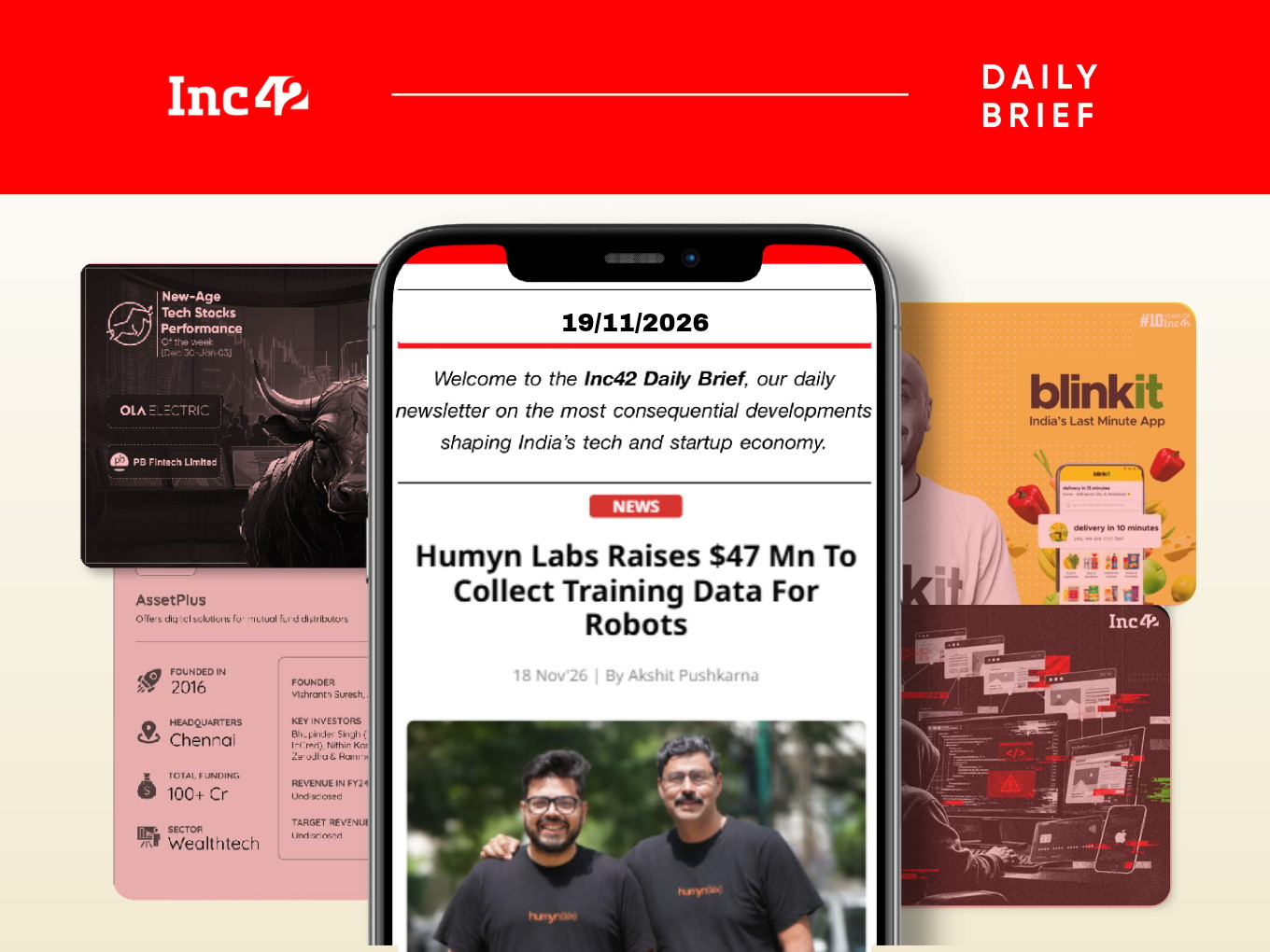
Humyn Labs’s $47 Mn Physical AI Play
Humyn Labs is capitalising on the physical AI gold rush. The startup has raised $47 Mn, via debt and equity, to scale its business of recording humans for training robots. As questions over privacy and consent linger, how is Humyn Labs building its warchest to dominate physical AI?
Funding Global Ambition: The round comprised $26 Mn in equity investment, which was led by Accel. The remaining $21 Mn was raised via debt from Lighthouse Canton and Trifecta Capital. The infusion will go towards expanding robot deployment operations to Brazil, South Korea and India, while strengthening its data collection hardware and processing capabilities. The corpus will also help scale the startup’s presence in San Francisco, London and Seoul.
A Rapid Rise: Founded earlier this year, the startup claims to have already $50 Mn in ARR within six months of operation. This pace of growth, coupled with the burgeoning physical AI data collection market, appears to have caught the attention of global investors. But the bigger ace up the startup’s sleeve is its tech stack and the scale of its operations.
A Sprawling Empire: Humyn Labs has developed its own two-camera hardware to record people performing everyday tasks. It then uses its software to process and label the footage, which is then used by robots for training. Overall, its data collection operations span more than 20 countries across Latin America and Asia.
The Contradictory Core: Beyond the headlines, the startup’s business model has raised serious questions around privacy, consent and data ownership. Recordings inside homes and factories could capture personal information, which has made consent and storage safeguards critical. Even deeper lies a stark labour paradox: workers are recording the very movements that will be used to train machines designed to automate their jobs.
Amid this backdrop, it will be interesting to see how Humyn Labs balances privacy safeguards, data usage and fair compensation. While that is a story for another day, here is all about Humyn Labs’ $47 Mn round…
From The Editor’s Desk
 From Blinkit To Vice City
- The quick commerce platform has started delivering download codes for Grand Theft Auto VI (GTA 6) in select areas across 11 Indian cities. The company plans to expand availability to more cities between November 18 and 19.
- The deliveries will see customers receive a physical box containing a digital download code for the game, rather than a traditional game disc. Buyers can redeem the code through the PlayStation Store and unlock the game.
- This comes as the Indian quick commerce market is projected to reach $40 Bn by 2030, driven by hyperlocal fulfillment, convenience and rising disposable incomes.
 Inside The Optimizely Hack
- The digital experience platform has been hit by a major data breach. Cyberattackers compromised customer projects on Optimizely Web and then used the platform’s content delivery network to distribute malware.
- This hack affected 178 companies including the likes of Zoom, BBC, CNN, Salesforce, GitLab and IKEA. The company has acknowledged the hack and claims to have already deployed a fix to fully remediate the vulnerability.
- The malware could also scan webpages for wallet addresses and substitute them with attacker-controlled ones, supporting Bitcoin and Ethereum. The attackers are said to have stolen nearly $7,151 via this method.
 Xiaomi’s Royalty Bill Comes Due
- Indian tax authorities are seeking to recover unpaid customs duties and penalties from the Chinese smartphone maker. The matter in question could potentially cost the OEM’s India business more than $150 Mn.
- Officials argue that Xiaomi’s royalty payments to vendors should be included in the value of imported components while calculating customs duties. The OEM claims that the parts were imported by its vendors and that royalties should not attract custom duties.
- This comes a couple of months after the SFIO recommended a detailed probe into alleged irregularities in Xiaomi’s business operations and possible FEMA violations. The OEM was earlier also probed for illegally remitted funds overseas in the name of royalty.
 Enerzolve Eyes $20 Mn
- The deeptech startup is in talks to raise around $16- 20 Mn (₹150-186 Cr) in a fresh round, which will likely be led by existing backer Jungle Ventures. There is also a possibility of a new investor joining the startup’s cap table.
- Founded in 2024, Enerzolve builds hardware and embedded systems for smart grids, renewable energy infrastructure and battery storage. It also offers original design manufacturing and customised engineering solutions for industrial players.
- The planned fundraise comes as the expansion of renewable energy capacity, smart meter deployments and battery energy storage projects is creating demand for local power electronics and grid management solutions.
 Airtel Payments Bank’s Q2 Show
- The payments bank’s net profit zoomed 139% YoY to ₹28.2 Cr in Q2 FY27 on the back of revenues rising nearly 9% YoY to ₹875.5 Cr, improving margins and growing adoption of its services. Meanwhile, EBITDA zoomed 39.4% YoY to ₹124.5 Cr.
- On the operational front, the payments bank said that its monthly transacting users (for savings bank account) grew 21.1% YoY to 3.1 Cr during the quarter under review, while customer balances grew 10% YoY to nearly ₹4,385 Cr.
- Airtel Payments Bank commenced operations in early 2017 with a seed investment of $440 Mn. It was the only profitable payments bank in the country in Q2 FY27 as rival Fino Payments Bank slipped into the red during the quarter.
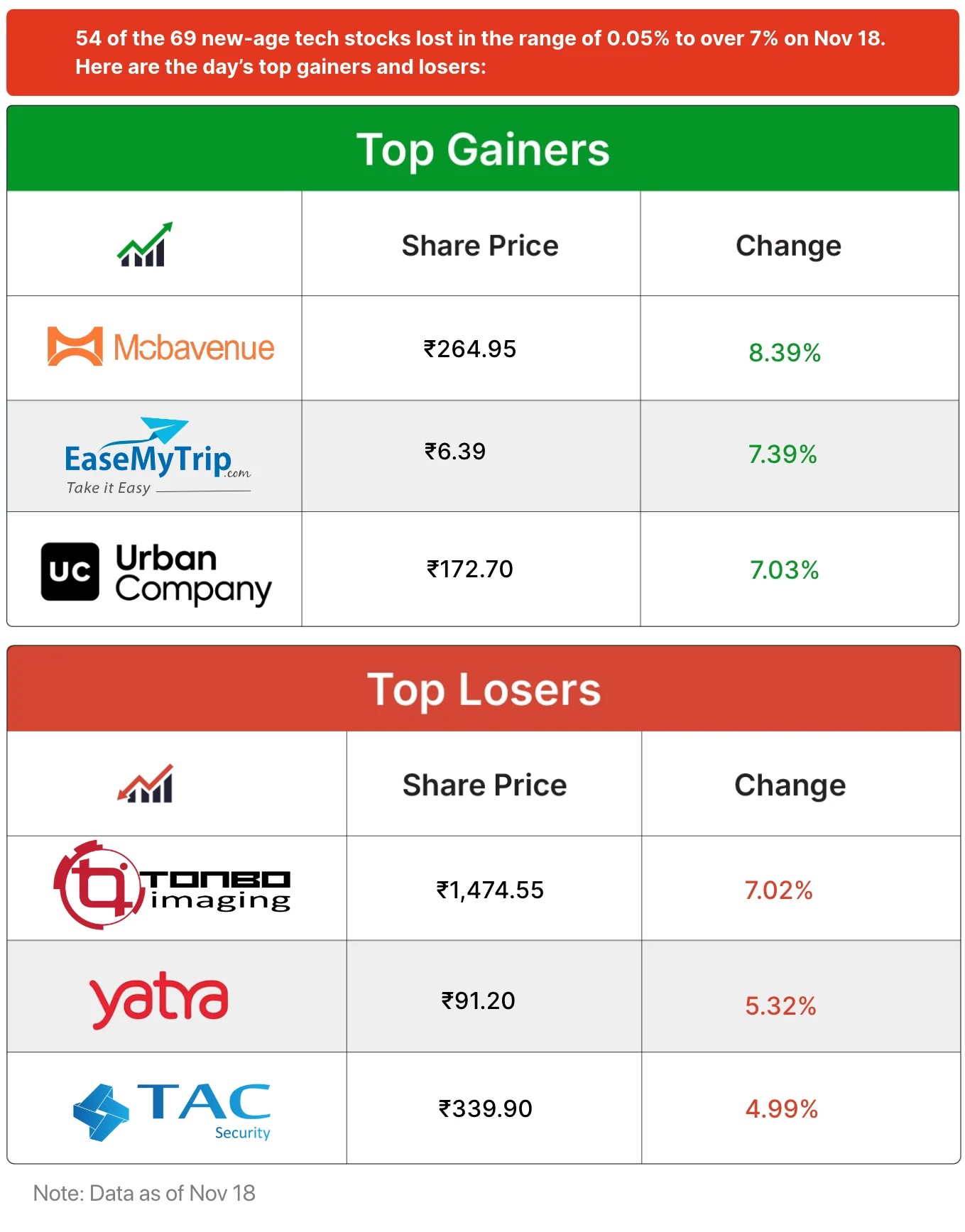
Inc42 Markets
Inc42 Startup Spotlight
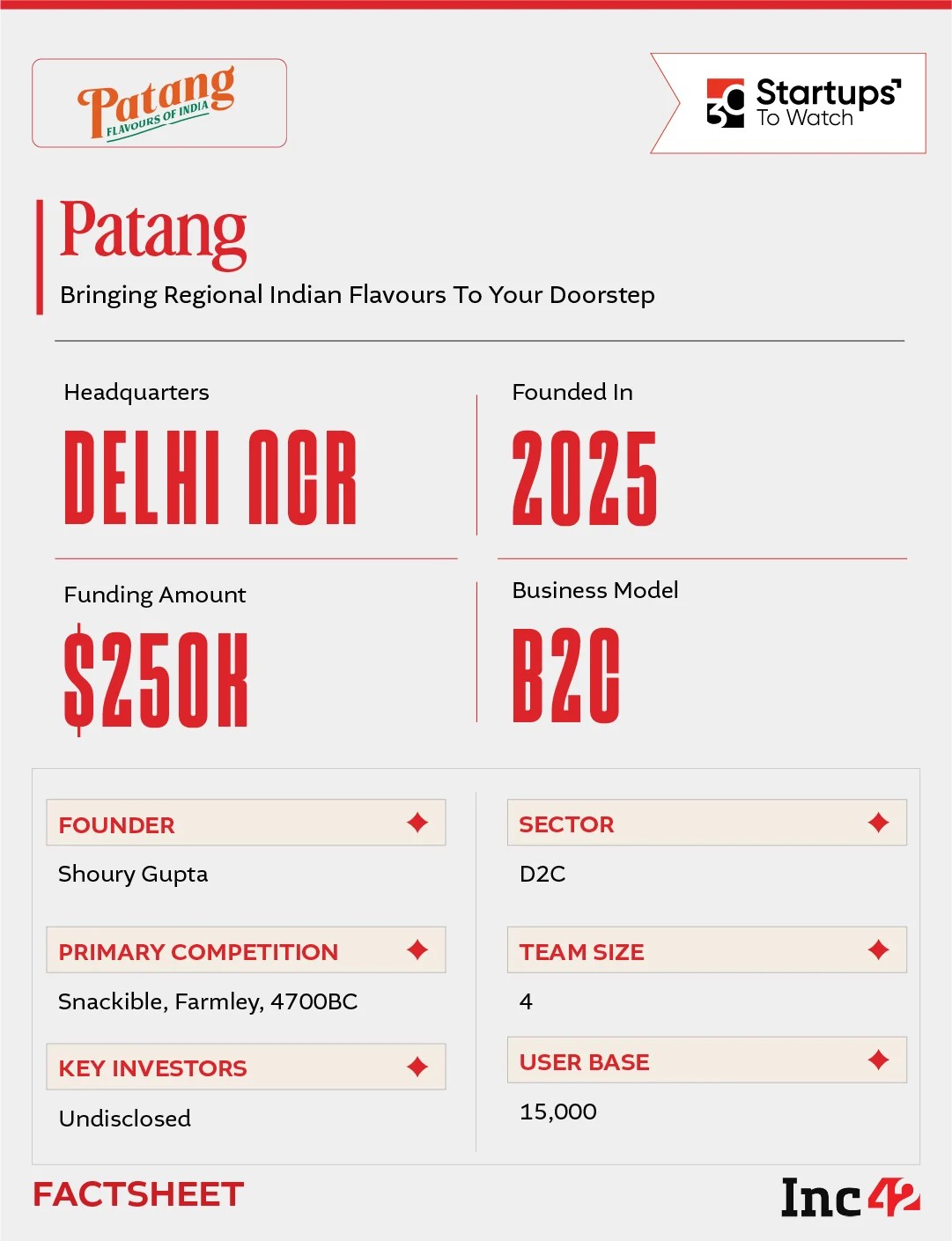
How Patang Is Putting Regional Indian Snacks On The Shelves
India’s culinary diversity is vast, but its snack aisle rarely reflects it. Popular regional treats are either unavailable outside their home markets or are reformulated for mass production. Enter Patang, a D2C brand that wants to make authentic regional snacks accessible across the country.
Delicacies At Doorsteps: Founded in 2025, Patang sells regional snacks such as Ratlami Sev, Jamnagari Chiwda, Jaipur Hing Chana, Darbhanga Makhana and Kollam Puli Inji. It partners with more than 20 manufacturing kitchens across India to bring these regional savouries to a wider market.
Made At Source: Instead of using a central industrial kitchen, Patang follows a decentralised model. It sources ingredients regionally and prepares products in small batches close to their places of origin. Final packaging and quality control are undertaken near Delhi. It oversees spice specifications, ingredients and batch checks to maintain consistency.
Patang’s Flavour Map: With 22 SKUs under its belt, the startup claims to have so far served more than 15,000 customers. It reported gross margins of around 70% in FY26 and monthly revenue growth of 43%. The brand now plans to expand into spices and condiments, strengthen sales and eventually enter markets with large Indian diaspora populations.
With India’s snack market projected to become a $43 Bn opportunity by 2032, can Patang turn local snacks into a national craving?
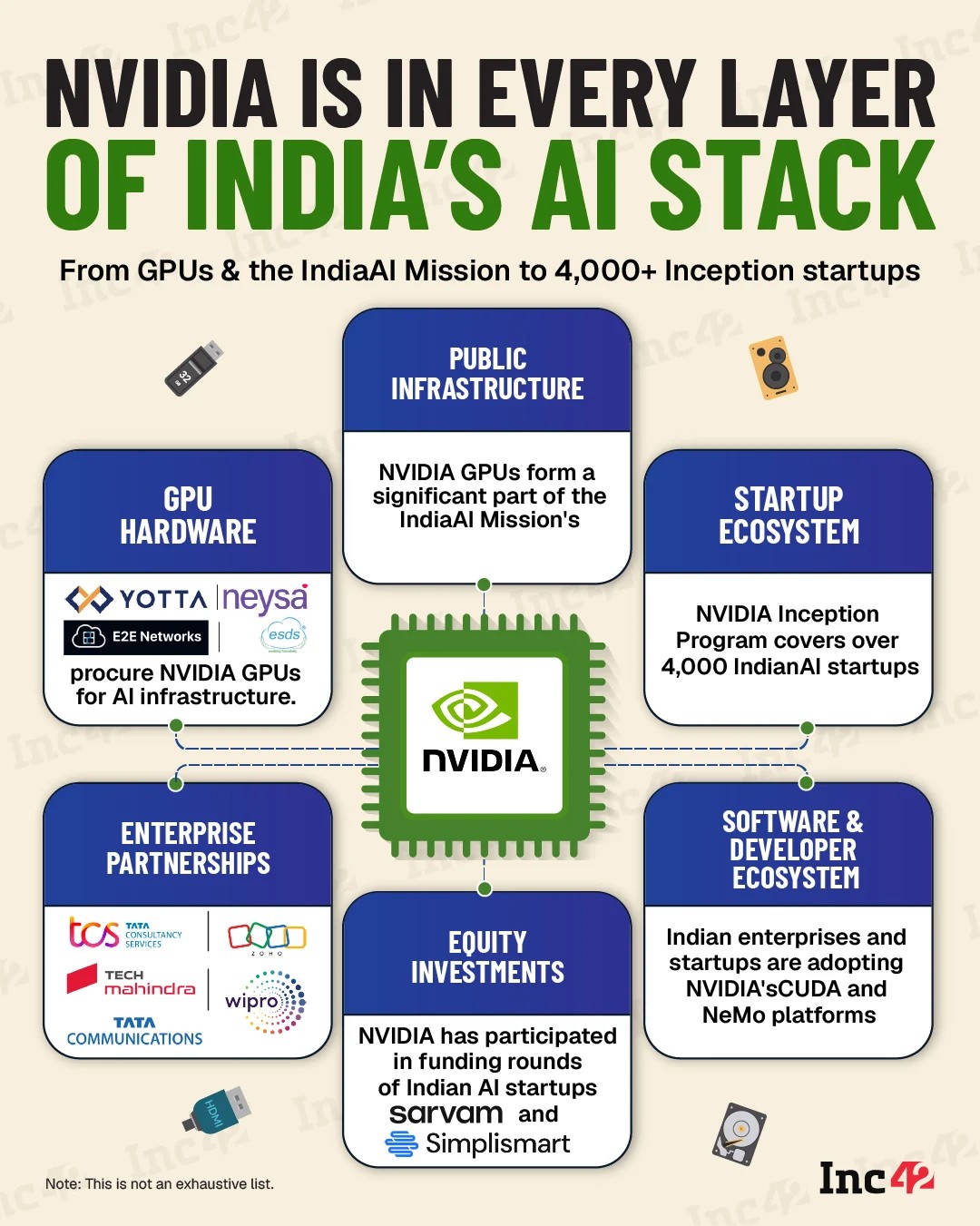
Infographic Of The Day
NVIDIA is everywhere in India’s AI ecosystem. From powering GPUs and public infrastructure to backing startups and partnering with enterprises, it’s playing a role at almost every level…
The post Humyn Labs’ $47 Mn Round, From Blinkit To Vice City & More appeared first on Inc42 Media.