
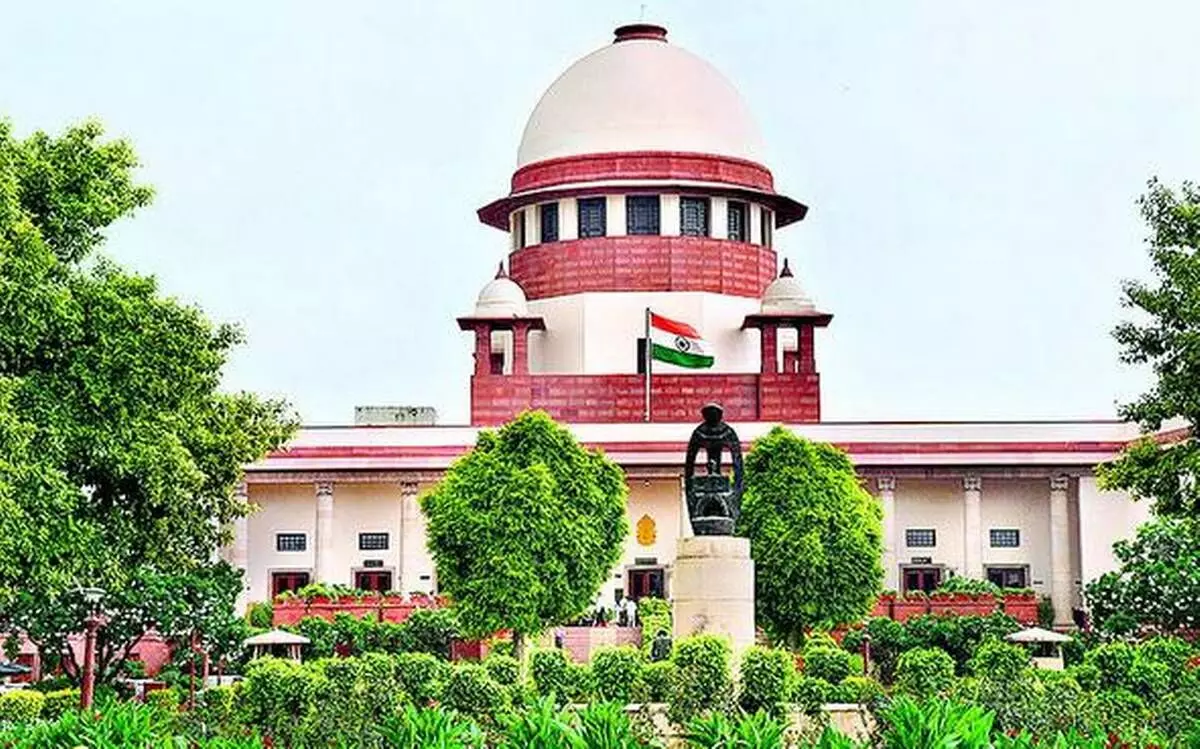
File image of the Supreme Court of India. (Photo: X)
New Delhi, Nov 18: The Supreme Court on Tuesday issued notice to the Centre and the Assam government seeking their responses to a petition filed by the All Assam Students’ Union (AASU) seeking reverification of the National Register of Citizens (NRC) published in Assam in 2019, alleging large-scale anomalies in the update exercise and the inclusion of names of suspected illegal Bangladeshi immigrants.
The development has revived the contentious issue of identifying illegal immigrants in Assam, with the influential student organisation maintaining that the final NRC failed to address the concerns that had led to the decades-long Assam Movement against illegal migration.
The matter came up before a two-judge bench comprising Justice Pamidighantam Sri Narasimha and Justice Alok Aradhe, which issued notice to the Centre and the State government after taking up AASU’s petition for hearing.
Reacting to the development, AASU chief advisor Samujjal Bhattacharya told The Assam Tribune in New Delhi that the organisation had approached the apex court seeking a fresh examination of the entire NRC update process, claiming that the exclusion of only around 19 lakh people from the final register had raised serious questions about its credibility.
“When the NRC was published in 2019, names of only 19 lakh people were excluded, raising doubts about the entire exercise. We submitted a petition seeking reverification so that Assam can have an NRC free from illegal Bangladeshi immigrants. Today, the Supreme Court admitted our petition for hearing and issued notice to the Central and State governments seeking their replies,” Bhattacharya said.
AASU president Utpal Sarma, who represented the organisation along with Bhattacharya before the court, said the petition sought a comprehensive re-examination of the NRC update exercise undertaken against the backdrop of Assam’s unique history of migration-related concerns.
“Assam is the worst-affected state in the country when it comes to illegal immigration. That is why the concept of NRC was prevalent only in Assam. A massive exercise was undertaken to update the 1951 NRC. However, when the register was published in 2019, only 19 lakh people were excluded. The people of Assam and AASU expected the number of foreigners in the State to be much higher,” Sarma said.
He also referred to a statement made in Parliament in 2005 by then Union Home Minister Prakash Jaiswal during the UPA government, claiming that nearly 50 lakh Bangladeshis were residing in Assam. AASU has cited such estimates to question the outcome of the NRC exercise.
The student body has also renewed its demand for a Special Intensive Revision (SIR) of electoral rolls in Assam, arguing that the identification of suspected illegal immigrants should not be confined to the NRC exercise but should also be reflected in the electoral verification process.
Bhattacharya said the Assam Movement, which began in 1979, was triggered by concerns over the presence of alleged illegal foreigners in the electoral rolls during the Mangaldoi Lok Sabha byelection.
“The Assam Agitation began over the inclusion of illegal Bangladeshi names in the voters’ list. Even today, we do not believe that Assam has a voter list free from Bangladeshis. We want a Special Intensive Revision of the electoral rolls,” he said.
He further maintained that the issuance of identity documents should be halted until a revised NRC, free from the names of illegal Bangladeshi immigrants, is published.
The demand for an intensive electoral roll revision assumes significance as the Assam election department last week published the draft electoral rolls under the Special Summary Revision (SSR) 2027, following the Election Commission’s decision last year to undertake a special revision exercise in the State.
The NRC, originally prepared in 1951, was updated under the supervision of the Supreme Court, with the final list published on August 31, 2019. The exercise was aimed at identifying Indian citizens in Assam in accordance with the applicable legal framework.
The final register excluded approximately 19 lakh applicants, triggering widespread debate over the outcome and subsequent demands for its acceptance and implementation.