
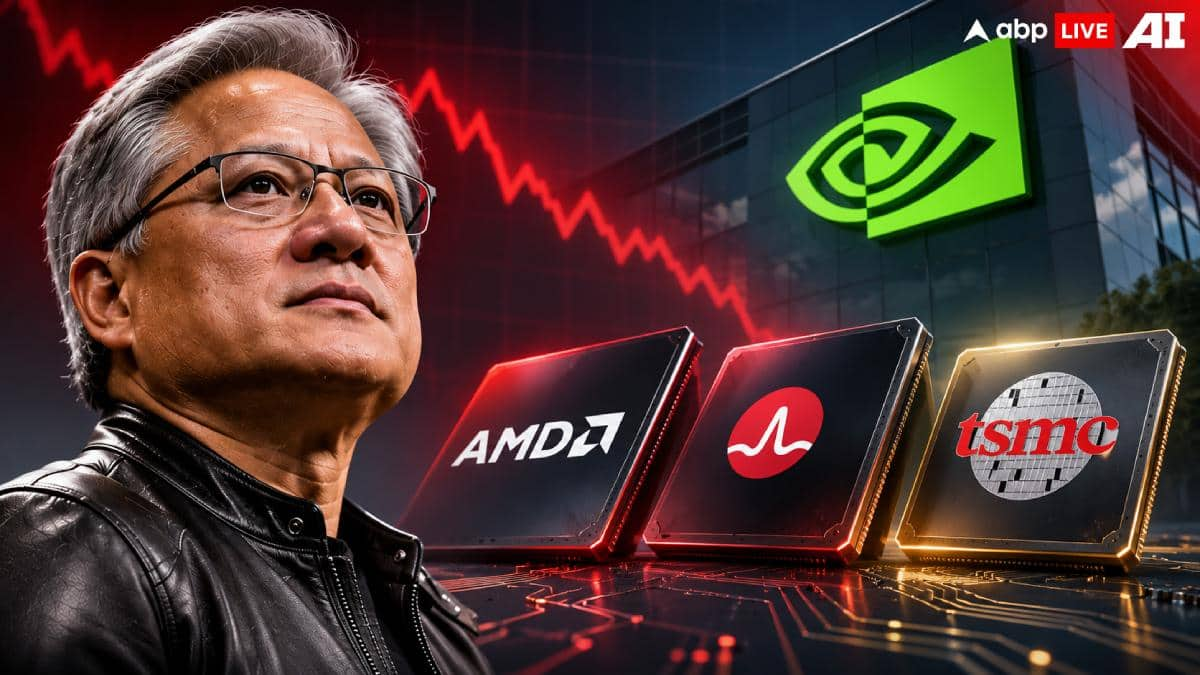
Nvidia's grip on the artificial intelligence (AI) chip industry is facing an unusual test, with a deepening leadership controversy involving CEO Jensen Huang adding to investor concerns about the technology sector's already volatile market environment. Reports of Huang's personal relationships, an independent board investigation and speculation about his future at the company have put the world's most influential AI chipmaker under intense scrutiny.
The developments could have implications far beyond Nvidia's boardroom. As investors assess the possibility of a leadership transition, attention is shifting towards rivals such as Advanced Micro Devices (AMD) and Broadcom, which are competing for a larger share of the rapidly expanding AI infrastructure market. Taiwan Semiconductor Manufacturing Company (TSMC), meanwhile, occupies a different but equally important position as the manufacturer supplying chips to several of the industry's biggest players.
However, a potential leadership crisis does not automatically mean Nvidia's competitors will inherit its business. The company's software ecosystem, manufacturing relationships and established position among data centre operators remain formidable advantages.
Jensen Huang Controversy Puts Nvidia's Leadership Under Scrutiny
The controversy has developed through a series of revelations over several days. On November 8, Nvidia announced an independent investigation into reports that Huang may have been targeted by a foreign intelligence operation.
The investigation followed media reports concerning his relationship with Alice Huang, a former executive of Singapore-based technology company Megaspeed, whom US authorities reportedly suspect of having links to Chinese intelligence. The two are not related.
Allegations that Megaspeed helped facilitate the movement of restricted AI chips to China have added a national security dimension to the controversy. Nvidia has said it has no reason to believe that company secrets or national security information were compromised.
NEW: Nvidia CEO Jensen Huang admits to cheating on his wife two days after a report dropped that U.S. intelligence believes he had a relationship with a Chinese spy. "I was unfaithful to my wife," Huang said in a letter to Nvidia staff. "My actions hurt her and our children. There is no excuse for what I did." "I love our country and our company, and I am committed to protecting Nvidia and supporting America's national security," he said. The company has launched an independent investigation into Huang to determine whether he was the "target of a foreign intelligence effort." The woman in question, alleged Chinese spy Alice Huang, is suspected of smuggling chips to China. Photos show her with the Nvidia CEO, and she is accused of funneling information to Beijing.
— Collin Rugg (@CollinRugg) November 8, 2026
Separately, Huang acknowledged having an extramarital relationship and apologised to his family and employees. Subsequent reporting by The New York Times alleged another relationship, this time with an Nvidia executive. The Wall Street Journal and CNN also reported that Nvidia's board was meeting to discuss Huang's future, with a possible removal being considered. These are reported developments, not confirmation that the board has removed him.
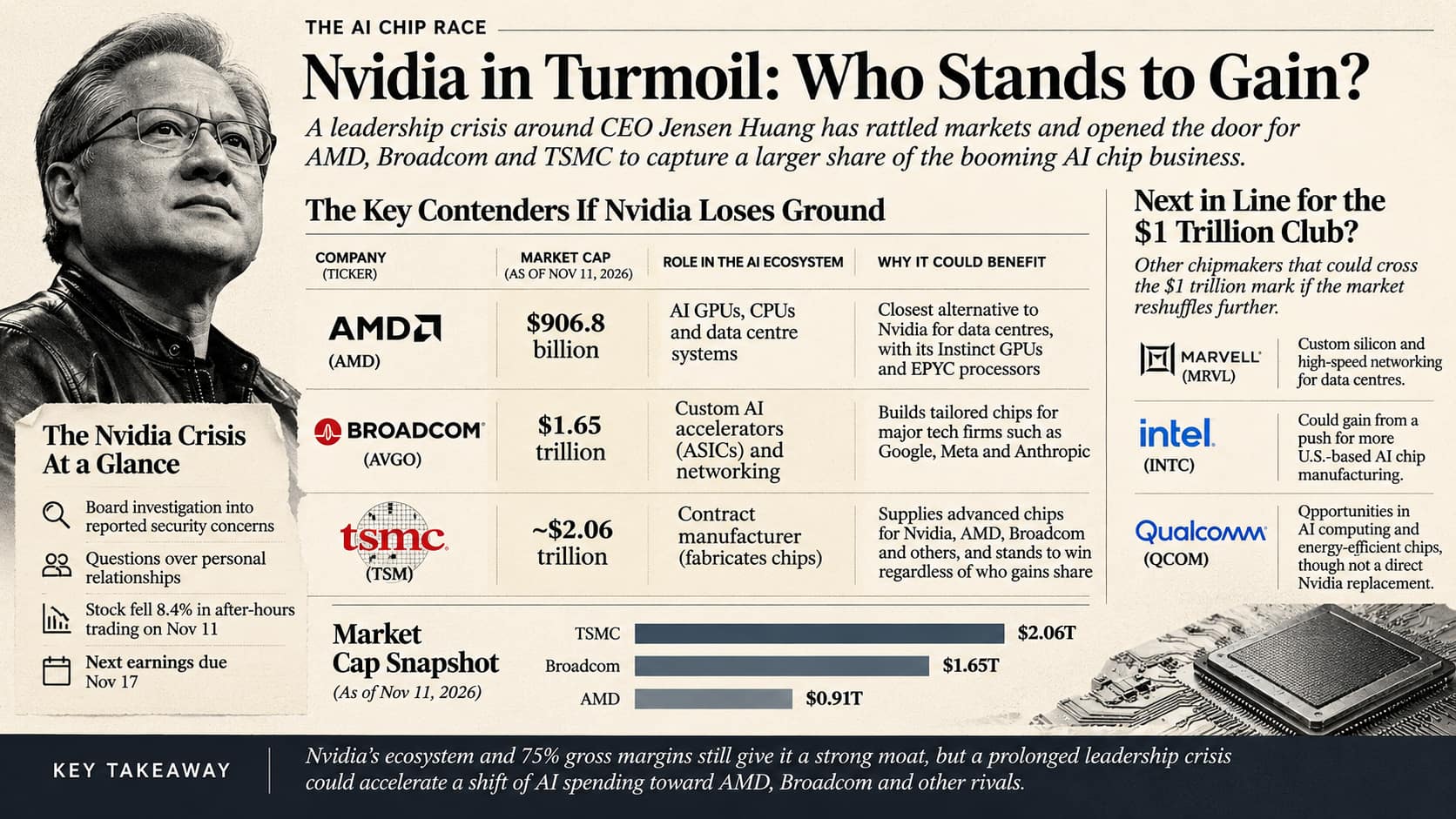
The financial fallout was immediate. Nvidia shares fell 8.4% in after-hours trading on November 11, according to CNN, following reports about the second relationship and the board meeting. The stock had already come under pressure earlier in the week as investors reacted to the investigation and concerns about the sustainability of AI infrastructure spending.
The timing is particularly sensitive because Nvidia is preparing to report its next quarterly results on November 17. Its second-quarter fiscal 2027 results, announced in August, showed revenue of $96.2 billion, up 106% year-on-year, while data centre revenue reached $89 billion. Its gross margin stood at 75%. The company's third-quarter revenue guidance was $108 billion, plus or minus 2%.
ALSO READ: Elon Musk Offers To Hire Jensen Huang Amid Nvidia Ouster Reports: ‘Would Be An Honour’
AMD Emerges As Nvidia's Most Direct Challenger
Among the companies positioned to benefit from any disruption at Nvidia, AMD is arguably the most direct competitor. Unlike businesses focused primarily on custom-designed accelerators, AMD offers data centre GPUs, CPUs and networking solutions that can form part of a broader AI computing infrastructure.
Its Instinct accelerator family and EPYC server processors give cloud providers an alternative when evaluating suppliers for large-scale AI deployments. However, replacing Nvidia is not simply a matter of purchasing a different GPU. Nvidia's CUDA software ecosystem, developer tools and established relationships with data centre operators create substantial switching costs.
AMD's market performance also reflects the growing investor interest in alternatives to Nvidia. Its market capitalisation stood at approximately $906.8 billion at the November 11 close, after a year in which its valuation had increased substantially. It had crossed the trillion-dollar threshold earlier in 2026 but slipped below it amid market volatility.
AMD's opportunity, therefore, lies in convincing major cloud providers that its hardware and software ecosystem can deliver competitive performance at scale. A prolonged leadership crisis at Nvidia could accelerate those conversations, although winning customers and converting deployments into sustained revenue will take time.
Broadcom's Custom AI Chips Could Become A Bigger Threat
Broadcom represents a different kind of competition. Rather than attempting to replicate Nvidia's GPU business, the company works with major technology firms to develop application-specific integrated circuits (ASICs), also known as custom AI accelerators.
These chips are designed around the requirements of individual customers, potentially allowing hyperscalers to reduce their dependence on Nvidia's expensive, general-purpose GPU infrastructure.
Broadcom's latest financial performance highlights the opportunity. In its third-quarter fiscal 2026 results, announced on September 2, the company reported AI semiconductor revenue of $16.7 billion, representing a 221% year-on-year increase. CEO Hock Tan said the company expected AI semiconductor revenue to reach $21.7 billion in the following quarter, up 236% from a year earlier.
Broadcom's market capitalisation stood at approximately $1.65 trillion on November 11. Its position in custom accelerators and high-speed networking makes it an important beneficiary of the growing trend towards specialised AI infrastructure.
The company's biggest opportunity could come from technology giants seeking greater control over their computing infrastructure. Google, Meta and other large cloud operators have been investing in custom silicon to optimise AI workloads and reduce reliance on external suppliers.
However, Broadcom's business also carries concentration risks. Its custom chip operations depend on a relatively small group of large technology customers, making future growth closely tied to their infrastructure spending decisions.
TSMC Could Win Regardless Of Who Takes Nvidia's Business
While AMD and Broadcom compete directly or indirectly for Nvidia's customers, TSMC occupies a different position in the semiconductor supply chain.
Taiwan Semiconductor Manufacturing Company is the world's leading contract chip manufacturer and produces advanced semiconductors for companies including Nvidia, AMD, Broadcom and Apple. It does not compete with these companies in chip design. Instead, it manufactures the processors and accelerators they develop.
This makes TSMC an important beneficiary of the wider AI infrastructure expansion, regardless of which chip designer gains market share.
Its latest financial results reinforce that position. TSMC reported October 2026 revenue of approximately NT$586.89 billion, an increase of 59.7% compared with October last year. Revenue for the first 10 months of 2026 rose 43.3% year-on-year to NT$4.49 trillion.
If cloud providers shift some of their orders from Nvidia to AMD or Broadcom, TSMC could continue manufacturing chips for those companies. Its advanced manufacturing capabilities therefore give it exposure to multiple potential winners in the AI semiconductor race.
Nevertheless, the company faces risks of its own, particularly geopolitical tensions surrounding Taiwan, enormous capital expenditure requirements and the technical challenges associated with developing increasingly advanced manufacturing processes.
Could Marvell, Intel And Qualcomm Join The AI Chip Race?
Beyond the three established contenders, other semiconductor companies could benefit from a more fragmented AI computing market.
Marvell Technology is one company worth watching. Its expertise in custom silicon, optical connectivity and data centre networking could make it an attractive partner for cloud companies looking to develop specialised AI infrastructure.
Intel and Qualcomm are also potential beneficiaries of a broader push towards diversified semiconductor supply chains, although neither currently offers a direct replacement for Nvidia's position in large-scale AI training.
Intel's manufacturing capabilities could become strategically important as governments and technology companies look to strengthen domestic semiconductor production. Qualcomm, meanwhile, has expertise in energy-efficient processors and AI computing, although its strongest opportunities currently lie outside Nvidia's core data centre GPU market.
For now, these companies remain secondary contenders rather than immediate replacements. A leadership disruption at Nvidia could create opportunities, but it would not automatically translate into contracts or market share for smaller competitors.
Nvidia's Biggest Advantage Remains Its Software Ecosystem
Despite the controversy, writing off Nvidia would be premature.
The company's competitive advantage extends well beyond the physical chips it sells. Its CUDA platform has become deeply embedded in AI development, with developers, researchers and businesses relying on its software libraries, programming tools and established infrastructure.
This ecosystem creates substantial switching costs. Moving from Nvidia to AMD or another chipmaker requires more than replacing hardware. Companies must also consider software compatibility, performance optimisation, developer training and the cost of migrating existing workloads.
The company's first-mover advantage and CUDA ecosystem have also been identified as significant barriers to competitors.
The scale of its business is another consideration. Nvidia reported $96.2 billion in quarterly revenue in fiscal Q2 2027, with gross margins of 75%. These numbers underline the extent of its commercial strength even as questions emerge about its leadership.
A change at the top could unsettle investors and create uncertainty around the company's strategic direction. However, its engineering teams, customer relationships, software infrastructure and product pipeline would not disappear with its CEO.
The Bigger Question: Can Anyone Replace Nvidia?
The unfolding controversy surrounding Jensen Huang comes at a critical moment for the semiconductor industry. AI infrastructure spending continues to create opportunities for chip designers, manufacturers and networking companies, but investors are also becoming increasingly sensitive to valuations, capital expenditure and the long-term returns from AI investments.
The market capitalisation figures also need perspective. As of November 11, AMD was valued at approximately $906.8 billion, while Broadcom stood at around $1.65 trillion. TSMC's latest operating figures underline its importance, although its valuation should not be confused with its manufacturing revenue.
For investors, the potential disruption at Nvidia presents several different opportunities. AMD offers the most direct competition in GPUs, Broadcom is positioned to benefit from custom AI accelerators, and TSMC remains central to manufacturing across the semiconductor industry.
But the bigger question is whether the AI chip market is heading towards a genuine redistribution of power or simply becoming more competitive while Nvidia retains its lead.
[yt]https://www.youtube.com/embed/NRVCgLkZRJw[/yt]
The answer could depend as much on Nvidia's ability to navigate its leadership crisis as on the technological progress made by its rivals. Its November 17 earnings report will offer investors another opportunity to assess the strength of its AI business amid the uncertainty.
For now, AMD, Broadcom and TSMC appear well positioned to benefit from a more diversified AI chip market. Replacing Nvidia, however, is an entirely different challenge.