

Employee stock options (ESOPs) have become a major talking point in India’s startup ecosystem this year, with questions around liquidity, employee wealth creation and the ability to monetise years of accumulated stock options taking centre stage. While Flipkart’s ESOP-related employee woes have been in the news all through this summer, digital commerce startup GoKwik has brought another dimension to the ESOP debate.
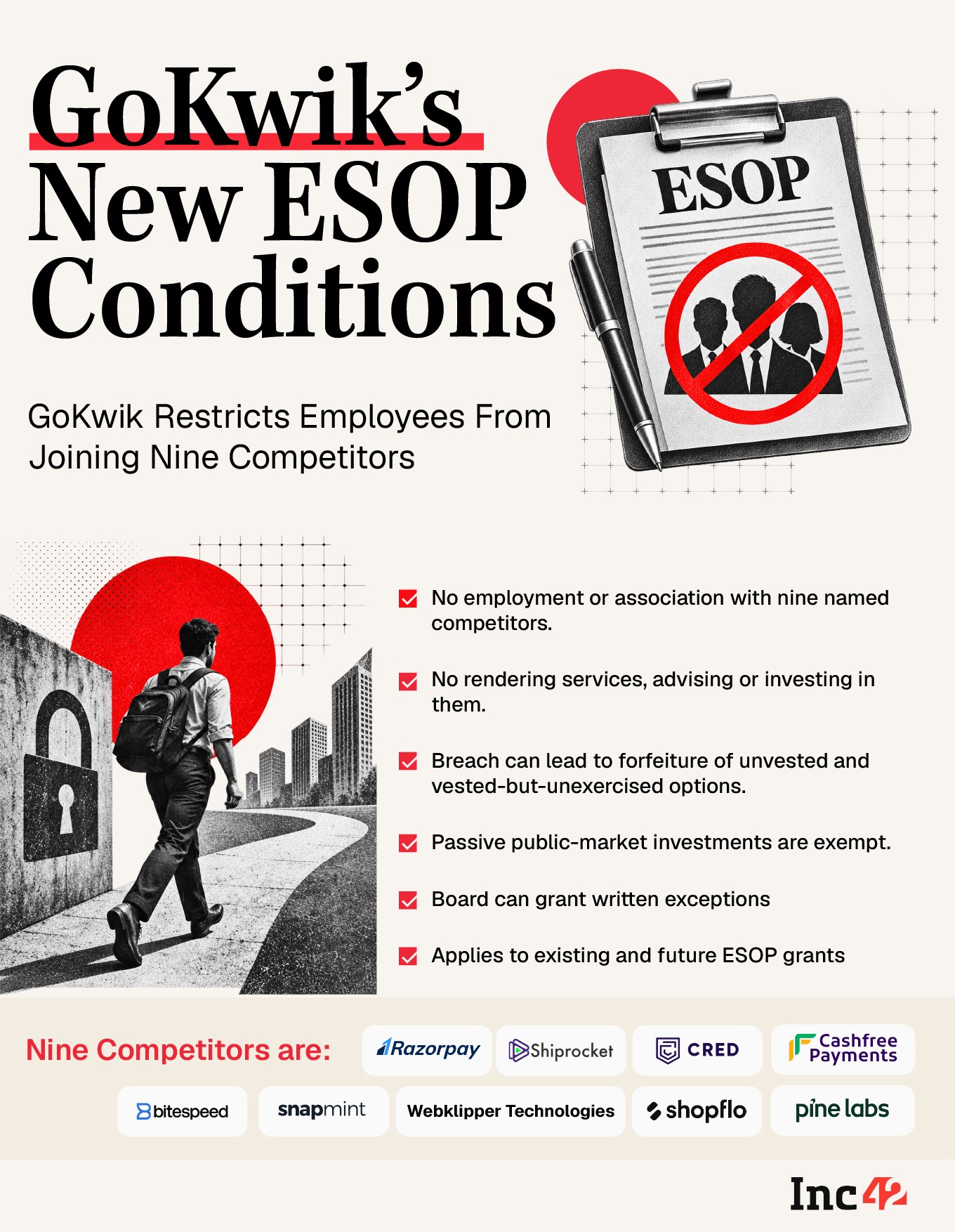
GoKwik, which is backed by the likes of Z47 Partners, Peak XV Partners, RTP Global and Think Investments, has amended its existing ESOP Plan 2021, through the insertion of a new non-compete clause, naming nine companies that employees are barred from joining or associating with, if they want to retain their ESOP rights.
The provision gives the startup the authority to revoke unvested and vested-but-unexercised employee stock options if employees (even those who have quit GoKwik) are found to have breached the restriction.
Inc42 has seen a copy of the internal document in question which has caused consternation among current and former employees. The mail was also sent to former GoKwik employees who continue to hold options.
The insertion of the clause has raised questions around employee mobility and the rights of existing ESOP holders, particularly as the new provision applies to options granted in the past as well as future stock options.
The clause was communicated to employees in the month of August, amid a spate of senior-level exits. The exits include vice president Sneha Rao, Sharad Gupta, the senior director of product management for the Checkout business, and Siddhartha Bahl, head of product, among others.
The policy lists Razorpay, Shiprocket, CRED, Cashfree Payments, BiteSpeed, Snapmint, WebEngage, Shopflo (acquired by Pine Labs), and Pine Labs as competing businesses.
Under the provision, employees cannot accept employment with, render services to, advise, invest in or otherwise associate with these companies. If the company determines that an employee has breached the restriction, it can forfeit their unvested options as well as vested options that have not yet been exercised.
The GoKwik ESOP Plan 2021 (“Plan”) allows GoKwik to cancel or forfeit both unvested and vested-but-unexercised options if the Board or Nomination and Remuneration Committee determines that an employee has committed a “Competitive Breach”.
While unvested options are stock options that employees are not yet entitled to exercise, vested-but-unexercised options are those that employees are entitled to exercise but have not yet converted into shares. The provision does not affect ESOPs that have already been exercised.
In effect, an employee joining a competing business could lose options that are yet to vest, as well as those that have already vested by have not been exercised. This means that even employees who completed the vesting period and earned the right to buy shares coils lose those options if the company determines that they have breached the competition restriction. However, options already exercised and converted into shares are not covered by this forfeiture provision.
Importantly, the restriction applies to all grants, whether issued before or after its effective date, and continues to bind former employees holding vested options even after their employment ends.
The restriction, however, is not indefinite. A special resolution passed by GoKwik shareholders at the company’s September, 2025 AGM provides that the competition related restriction will remain in force from the grant date until two years after an employee;s last date of employment or engagement with the company or its affiliates. In other words, the restriction applies throughout an employee’s tenure at GoKwik and continues for two years after their departure. During this period, joining or associating with a competing business could put their outstanding ESOPs at risk.
The policy appears to carve out passive investments in publicly traded securities. It also allows the GoKwik Board to approve exceptions in writing, with employees required to write to the company for such deviations.
The inclusion is significant because it directly links an employee’s association with named competitors to the potential loss of their stock options, including options that have already vested but remain unexercised.
Questions sent to GoKwik didn’t elicit any response at the time of publishing the story even after Inc42 extended the deadline for responses upon the company’s request.
Instead, GoKwik issued a press release claiming former employees might get 9X average returns on their ESOPs and the startup has turned EBITDA positive in October 2026. But this press release does not mention any of the concerns that employees have brought up.
Employees In Limbo
“The sudden change in the ESOP policy was a shock. People who have quite a significant ESOP holding are all of a sudden in fear that they will lose it if they leave the company and try to join a better company. Now the names that they have mentioned are much superior companies that they would want to join as part of having a better career trajectory,” a former GoKwik employee told Inc42.
Employees with significant ESOP holdings, particularly those who may consider moving to other companies in the same sector, are stuck in limbo.
Sources in the company say they are weighing potential job opportunities against the potential loss from forfeiting their outstanding stock options. This is especially relevant for employees whose options have vested but have not been exercised, since the new clause explicitly includes vested-but-unexercised options within the scope of potential forfeiture.
The forfeiture, however, is not automatic. The Board or the Nomination and Remuneration Committee has the discretion to determine whether an employee has committed a “Competitive Breach” and decide whether to cancel or forfeit their unvested and/or vested-but-unexercised options.
Worryingly for employees, the provision is ambiguous about what kind of relationships are covered. For instance, it says that ESOPs may be revoked for employees who may “otherwise associate” with a competing business. This could cover relationships beyond direct employment, and the policy does not make the scope of this phrase immediately clear.
The timing of the amendment is also notable against the backdrop of GoKwik’s growth ambitions and recent senior-level departures as well as layoffs.
Founded in 2020 by Chirag Taneja, Vivek Bajpai, and Ankush Talwar, GoKwik is an ecommerce enablement startup that offers software tools to help online brands improve checkout, reduce order returns, automate customer engagement and increase sales. Earlier this year, Inc42 exclusively reported that GoKwik had laid off around 120 employees.
The startup has to date raised $68 Mn in funding and counts investors including Peak XV Partners, Z47 Partners, RTP Global, and Think Investments, among others.
In an interview with BW Disrupt, published in July 2025, cofounder and CEO Taneja said the company generated around ₹250 Cr in revenue in FY25. However, GoKwik Commerce Solutions Pvt Ltd’s financial disclosures show consolidated operating revenue of ₹146.2 Cr for FY25, and total consolidated revenue of approximately ₹163 Cr. GoKwik did not respond to questions about this discrepancy.
Among the nine companies named in the policy, GoKwik directly competes with the likes of Shiprocket’s Fastrr, Razorpay’s Magic Checkout, Shopflo, and Cashfree’s One Click Checkout, while the remaining companies operate in adjacent or overlapping segments of ecommerce enablement, fintech, and merchant services ecosystem.
Making Sense Of Non-Compete For ESOPs
Non-compete restrictions are commonly included in employment agreements in India, although their enforceability is difficult to establish.
However, explicitly naming competitors in an ESOP policy and linking an employee’s association with them to the cancellation of vested-but-unexercised options is unusual, according to Siddharth Manchanda, Partner at JSA Advocates & Solicitors. Manchanda further clarified that his comments reflected a general understanding of the law and should not be construed as an opinion on GoKwik.
He also said that a restriction on an ESOP policy is unusual but its substance is not entirely new. Most ESOP policies, in his view, contain provisions that allow options to lapse if an employee breaches their employment agreement.
Since employment agreements commonly include non-compete restrictions, companies may already have an indirect route to link an employee joining a competitor with the loss of ESOPs.
However, companies do not typically go after employees solely for joining a competitor, unless the situation also involves allegations of confidentiality breaches, data theft or misuse of proprietary information.
Under Rule 12(8)(f) of the Companies (Share Capital and Debentures) Rules, 2014, unvested options ordinarily expire upon resignation or termination, while vested options can be exercised within the period specified by the ESOP scheme.
The more consequential question, according to Manchanda, is whether a company can introduce additional grounds for forfeiture after employees have already received their options. While employers have discretion to set the grounds for cancellation when drafting an ESOP policy, changing those terms later to employees’ disadvantage could be legally questionable.
In GoKwik’s case, the amendment applies to options that were already outstanding.
As per another lawyer Inc42 spoke to, this change could be challenged from a legal standpoint, as amendments that adversely affect employees’ existing ESOP rights raise questions around their validity. He added that the enforceability of non-compete restrictions and the cancellation of ESOPs on that basis remains an unsettled issue that could be tested in legal dispute.
ESOPs Turn Into A Governance Question
The clause also raises a governance question that goes beyond enforceability. Plus, some clauses in the changed policy are ambiguous at best.
Under the plan, it is the Board or its Nomination and Remuneration Committee that decides whether an employee has committed a “Competitive Breach”, a decision in which employees, and the former employees the clause continues to bind, have no part.
ESOPs are a critical lever when it comes to attracting employees to early stage startups. They stand in for salary. An early stage startup can’t match what IT services giants, multinationals or global capability centres (GCCs) pay.
Stock options fill the gap. The employee takes a lower monthly salary in exchange for a share of the upside in the future. At that stage the ESOP is part of the offer, not a perk.
ESOPs are also seen as a retention tactic. Options vest over time and it ties in employees to the success of the business in the long run. Leaving early means giving up the options that haven’t vested or even leaving money on the table.
And finally, ESOPs are one wealth creation instrument in the hands of employers. A total of 12 startups executed ESOP buybacks in 2025, paying ₹1,409 Cr ($158 Mn) to more than 9,200 employees. In 2024, 23 startups paid out ₹1,448 Cr to employees through buybacks.
Even a minor change in the ESOP policy can lead to employees having to sacrifice an amount that can be equivalent to years of salary.
GoKwik would not be the first startup to change ESOP terms after the options were granted. In December 2025, Unacademy cut the window its former employees had to exercise their vested options from 10 years to 30 days, while it was in M&A talks. Unacademy put the change on hold a month later, after a backlash from former employees.
GoKwik’s claim of 9X average returns for former employees tells us what the options may be worth, but do employees get to keep them?
GoKwik’s handling of the issue will be tested the first time an employee with vested options joins one of the nine companies it names, unless, like Unacademy, the ecommerce company decides to revisit this provision before then.
Until that happens, every employee holding ESOPs, current or former, is left with the question: does a vested option actually belong to them even if it has been allocated on paper, or is it only theirs for as long as they stay away from the companies that GoKwik bars?
Edited By Nikhil Subramaniam
Creatives: Varshita Srivastava
The post GoKwik’s Golden Handcuffs: Non-Compete Clause Puts Vested ESOPs In Jeopardy appeared first on Inc42 Media.