
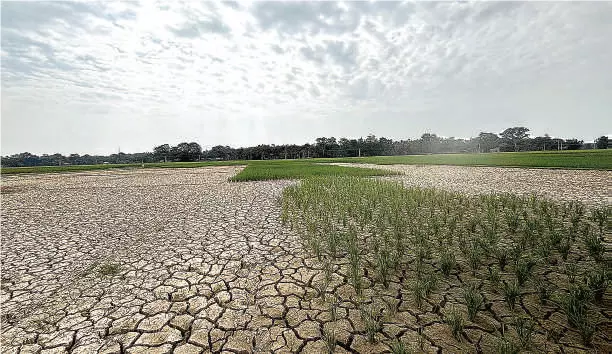
In several stretches of farmland, the drying surface soil has developed deep cracks, while heavy deposits of silt and sand have left farmers uncertain about their next crop cycle.
Sivasagar, Nov 10: Three months after the devastating floods, several pockets of upper Assam are facing the prospect of a deepening economic crisis, with agricultural land rendered unfit for cultivation, crops showing signs of distress and farmers struggling to find fodder for their cattle.
The impact of the deluge is becoming increasingly evident across affected areas. In several stretches of farmland, the drying surface soil has developed deep cracks, while heavy deposits of silt and sand have left farmers uncertain about their next crop cycle. The scarcity of grass for cattle has further compounded their woes.
Agriculture experts have identified Kamal Chapori, Bamunpukhuri, No. 1 Chintamoni Garh and Nepali Khuti (Sivasagar district) and Disang Pani (Charaideo) among the worst-affected areas. However, several other locations are yet to be formally reported.
Villagers told The Assam Tribune that although some farmers have resumed cultivation, the results have been discouraging. Vegetables such as bottle gourd and lai saak, which initially showed signs of growth, have begun turning reddish within a few weeks.
“We are collecting soil samples from these areas. Deposition and siltation in some places are as high as three to four feet. Broadly, there are two types of deposits – clay loam and sandy loam,” said Dr Arundhoti Bordoloi of Krishi Vigyan Kendra (KVK), Sivasagar.
“The management practices will vary depending on the nature of the deposition. In clay loam soil, standing water is required for paddy cultivation. If there is a shortage of water, paddy will not grow," she added.
Referring to the surface cracks reported in some agricultural fields, she said the phenomenon had been observed in areas where floodwater remained stagnant for several days – up to September in some cases.
In an attempt to help farmers recover, agriculture officials have begun distributing mustard seeds in areas where paddy was traditionally cultivated. However, the prospects remain uncertain.
“Paddy growth has remained stagnant in some areas. Even mustard cultivation might fail in these places,” officials said. However, farmers in certain other pockets have managed to resume vegetable cultivation with encouraging results.
The crisis is not confined to farmland. The acute shortage of grass and other fodder has forced some farmers to sell their cattle, while some animals have reportedly died due to the scarcity. Villagers in Chintamoni Garh fear that the prolonged distress could trigger serious socioeconomic consequences in the coming months.
The floods have also dealt a severe blow to the poultry sector. Sivasagar district alone lost around seven lakh poultry birds and ducks, while neighbouring Charaideo district reported losses of approximately one lakh birds, leaving thousands of farmers in financial distress.
To support the affected farming community, KVK Sivasagar and the agriculture department have mobilised inputs worth over Rs 46 lakh, including seeds and fodder. They have also been providing technical advice and other forms of assistance to help farmers resume agricultural activities.
The scale of the damage, however, remains substantial. According to district agriculture officer Amrit Saikia, more than 3,470 hectares of agricultural land in Sivasagar district will require desiltation before cultivation can resume.
The district administration has proposed financial assistance of Rs 6.25 crore for 6,055 farmers to facilitate the process. “The amounts will be credited directly to the farmers’ bank accounts. They will undertake desiltation work according to their individual requirements,” Saikia said.
With large tracts of farmland still awaiting restoration and livestock owners struggling to secure fodder, the long road to agricultural recovery could have serious economic implications for flood-affected communities across the affected areas.