
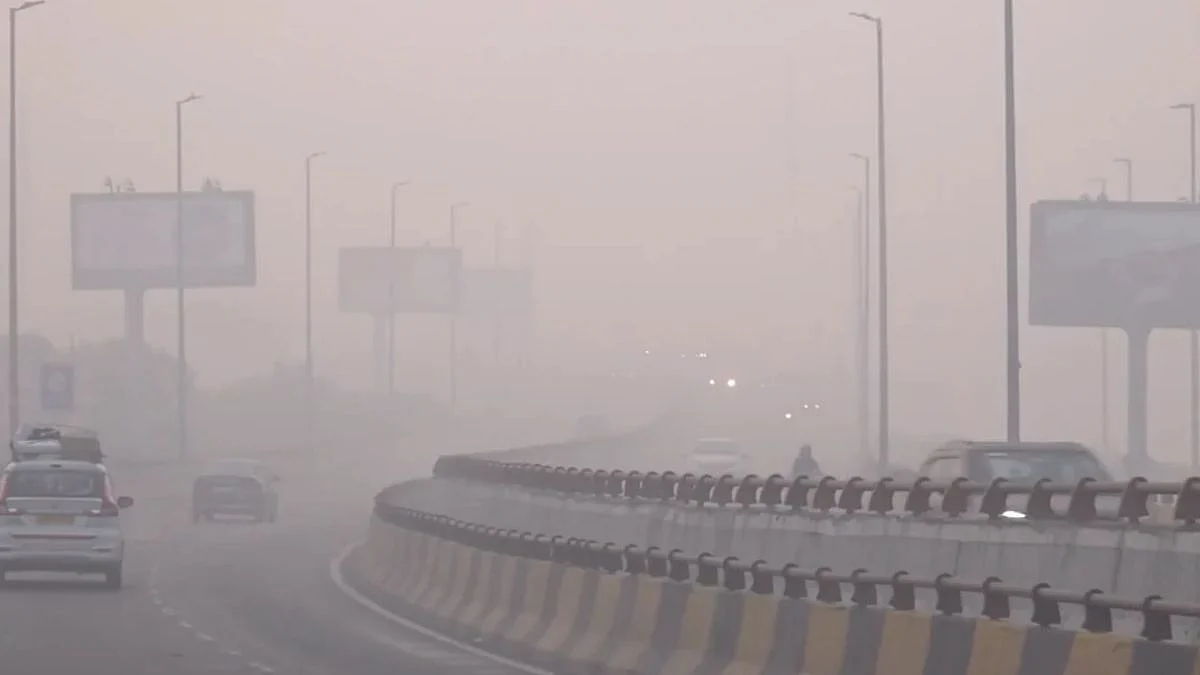
New Delhi: A day after Diwali celebrations, Delhi's air quality deteriorated to the brink of the 'severe' category on Monday morning, with the Air Quality Index (AQI) touching the 400 mark, as thick smog engulfed several parts of the national capital and reduced visibility during the early morning hours.
Pollution at its peak: This is how Delhi looks after Diwali. AQI: 1500+ pic.twitter.com/NKSkQyCHCN
— . (@ersalmanahanger) November 9, 2026
A thick blanket of smog was particularly visible around the Inderlok area, while several other parts of the city woke up to hazy conditions, with deteriorating air quality and poor visibility adding to concerns among residents.
According to the Central Pollution Control Board (CPCB), the AQI around Ghazipur stood at 418, categorised as 'severe', while the reading around Akshardham was 337, falling in the 'very poor' category.
VIDEO | Thick smog blankets Delhi's Akshardham Temple and Barapullah flyover on the morning after Diwali, as the Air Quality Index (AQI) around Akshardham stands at 337, in the 'Very Poor' category, according to the Central Pollution Control Board (CPCB).
— Press Trust of India (@PTI_News) November 9, 2026
(Full video available… pic.twitter.com/S3DuRkUiOd
Several monitoring stations across Delhi recorded AQI levels above 400. Burari Crossing registered the highest reading at 441, followed by Vivek Vihar at 437, Delhi Technological University (DTU) at 434, North Campus of Delhi University and Jahangirpuri at 433 each, and Rohini at 430.
Other locations in the severe category included Mundka at 417, Punjabi Bagh at 409, NIH Narela at 407 and ITO at 407.
Among other monitoring stations, CRRI Mathura Road recorded an AQI of 396, Aya Nagar 386, Talkatora Garden 384, NSUT Jaffarpur 378, Lodhi Road 370, Mandir Marg 369, Wazirpur 365, R K Puram 364, Badarpur 363, IHBAS Dilshad Garden 363 and Dr Karni Singh Shooting Range 361.
Najafgarh recorded an AQI of 340, Anand Vihar 335, IMD Lodhi Road 323, Ashok Vihar 319 and Sri Aurobindo Marg 267. Data for IIT Delhi and Dwarka Sector 8 was unavailable.
The worsening air quality comes after the Commission for Air Quality Management (CAQM) on Friday invoked Stage III of the Graded Response Action Plan (GRAP) across Delhi-NCR, three days ahead of Diwali, amid concerns over further deterioration in pollution levels.
Meanwhile, Mumbai also witnessed hazy conditions, with a thick layer of smog blanketing the Kalanagar and Bandra areas amid worsening air quality.
According to monitoring data, Kherwadi-Bandra East recorded an AQI of 264, followed by Sewri at 226, Ghatkopar at 221 and Chembur at 216. Byculla recorded an AQI of 193, Mindspace-Malad West 191, Kandivali West 187 and Worli 148. Kurla recorded an AQI of 96.
In Photos: From Resplendent Lights To Traditional Attire, A Look At How Mumbai Celebrated Diwali 2026In Uttar Pradesh, a thick layer of smog blanketed Lucknow as several parts of the city woke up to hazy conditions.
According to CPCB classification, an AQI between 0 and 50 is considered 'good', 51-100 'satisfactory', 101-200 'moderate', 201-300 'poor', 301-400 'very poor' and 401-500 'severe'.
With Stage III measures in force following the CAQM's decision, existing restrictions will continue alongside additional pollution-control measures, increased enforcement and directions to concerned agencies to prevent further deterioration in air quality.
The emergency action plan applies across Delhi and adjoining districts of Haryana, Uttar Pradesh and Rajasthan. It is invoked as a precautionary measure based on meteorological and pollution forecasts provided by the India Meteorological Department (IMD) and the Indian Institute of Tropical Meteorology (IITM), allowing restrictions to be implemented before citywide AQI levels reach the 'severe' category.
Diwali 2026: Chennai Sees Massive Travel Rush As 15 Lakh Passengers Head Home, Special Buses & Trains DeployedGRAP is a four-stage emergency framework managed by the CAQM in coordination with the CPCB and regional state governments. Restrictions become progressively stricter as air quality deteriorates.
Under Stage I, triggered when the AQI is between 201 and 300 and categorised as 'poor', the focus is on controlling road dust, enforcing pollution norms and prohibiting open waste burning.
Stage II comes into force when the AQI is between 301 and 400, categorised as 'very poor'. It entails enhanced dust-control measures, higher parking fees and staggered office timings.
Stage III is invoked when the AQI reaches the 401-450 range, classified as 'severe', and includes stricter vehicle restrictions, a halt to construction activities and hybrid learning arrangements for primary school students.
Stage IV, applicable when the AQI exceeds 450 and enters the 'severe plus' category, involves restrictions on heavy goods vehicles and emergency measures targeting traffic and industrial pollution.
Level up your brain the fun way. Play daily games and quizzes on FPJ Smart!
(Except for the headline, this article has not been edited by FPJ's editorial team and is auto-generated from an agency feed.)