
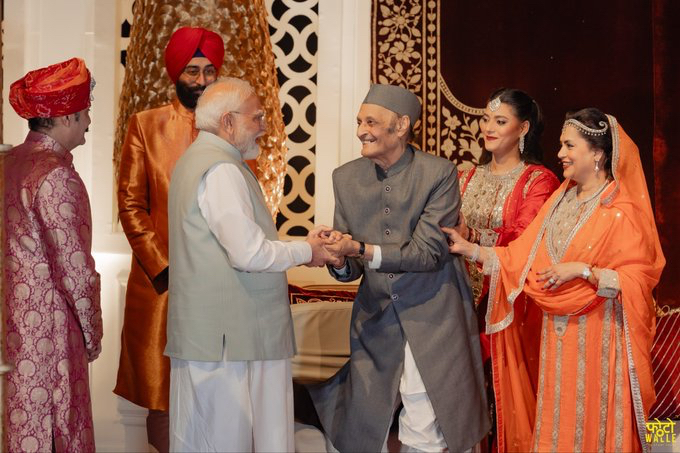
The elaborate wedding of former Punjab Finance Minister Manpreet Singh Badal’s daughter to the grandson of Congress veteran Karan Singh was the talk of New Delhi this week.
At the heart of the discussion was not merely the VVIP guest list, led by Prime Minister Narendra Modi on the political side and Radha Soami Satsang chief Gurinder Dhillon on the spiritual front, but also the role of marriages in perpetuating historical ties between royalty and politics in India.
Rhea Badal’s marriage to Martand Singh further strengthens these links, bringing another politically influential family from Punjab — the Badals — into a matrimonial alliance with the Dogra royal family of Jammu.
The wedding brought together several prominent royal and political families, many already connected through matrimonial alliances, were present in all their fineries.
These included the Dogra clan led by Karan Singh; the Rampur-Bushahr royal family of Himachal Pradesh, represented by Pratibha Singh; the Scindia dynasty of Gwalior from central India, represented by members of the family; and the Patiala royals of Punjab, represented by Capt Amarinder Singh’s daughter Jai Inder Kaur whose private residence served as the venue for the reception.
While Rhea married into the Dogra royal family, with the weeklong celebrations culminating in an Anand Karaj at the Lutyens’ Delhi residence of Shiromani Akali Dal leader Harsimrat Badal on Wednesday, several of the aforementioned clans are already connected by matrimony.
Capt Amarinder Singh’s grandson Angad Singh is married to Aprajita Singh, daughter of Pratibha Singh of the Rampur-Bushahr royal family. Chitrangada Raje, married to Vikramaditya Singh, son of Karan Singh, is the daughter of the late Madhavrao Scindia and sister of Union Minister Jyotiraditya Scindia, who attended Rhea’s wedding.
Another of Capt Amarinder Singh’s grandsons, Nirvan Singh, is married to Karan Singh’s granddaughter, Mriganka.
Rhea Badal’s marriage to Martand Singh thus brings two more prominent royal and politically influential families — the Badals of Punjab and the Dogras of Jammu — into a matrimonial alliance.